
R&D Center Update

KK Field Logger enters the field evidence AI stage.

K&K Data Service is advancing KK Field Logger from field media capture toward a structured evidence platform for construction records, project review, finance checks, and operational risk control.

Crew working on a metal frame at a real field site used for KK Field Logger AI evidence review

Real Field Inputs

Field evidence AI is being tested against practical site images, not clean demonstration samples.

Published

May 9, 2026

Category

Company Update / R&D Center

Product Direction

KK Field Logger

Scope Note

This article describes current R&D validation and platform direction. AI outputs are designed to support review, not replace project managers, finance reviewers, inspectors, or professional judgment.

K&K Data Service Inc. announces that KK Field Logger has completed a new round of core R&D validation. The platform is no longer being treated as only a photo upload tool. It is moving toward a field evidence AI platform for site records, project management, finance review, and enterprise risk control.

In the past, field photos were often only saved. The current direction is different: every photo, video, voice note, receipt, GPS point, comment, and report should become part of a traceable record that can be reviewed, audited, summarized, and used for decisions.

From Photo Library To Field Evidence System

KK Field Logger already supports multiple foundation capabilities: field uploads from app and H5 workflows, photo and video records, receipts, voice comments, GPS points, project views, employee and permission management, comments, notes, maps, trash recovery, batch review, and report generation.

AI queue processing, Copilot workflows, deeper reports, and receipt fact extraction have moved into usable R&D stages. Together, these capabilities turn field media into a structured data layer that can support project managers, enterprise administrators, and finance teams.

AI Direction: Facts Before Narration

K&K's R&D position is that ordinary AI image captions are not enough for field management. A sentence like "people are working on site" is too vague. What matters is whether a manager can understand how many people appear, what activity is visible, what materials or equipment are present, whether there are safety or staging concerns, and whether the image can support a project, finance, or customer communication record.

For that reason, the AI direction is not simply more prompt writing. The team is building a field evidence engine that favors structured facts, confidence, conflict handling, and review flags.

UploadDetectExtract FactsResolve ConflictsManager SummaryAudit Trail

Layered AI Architecture

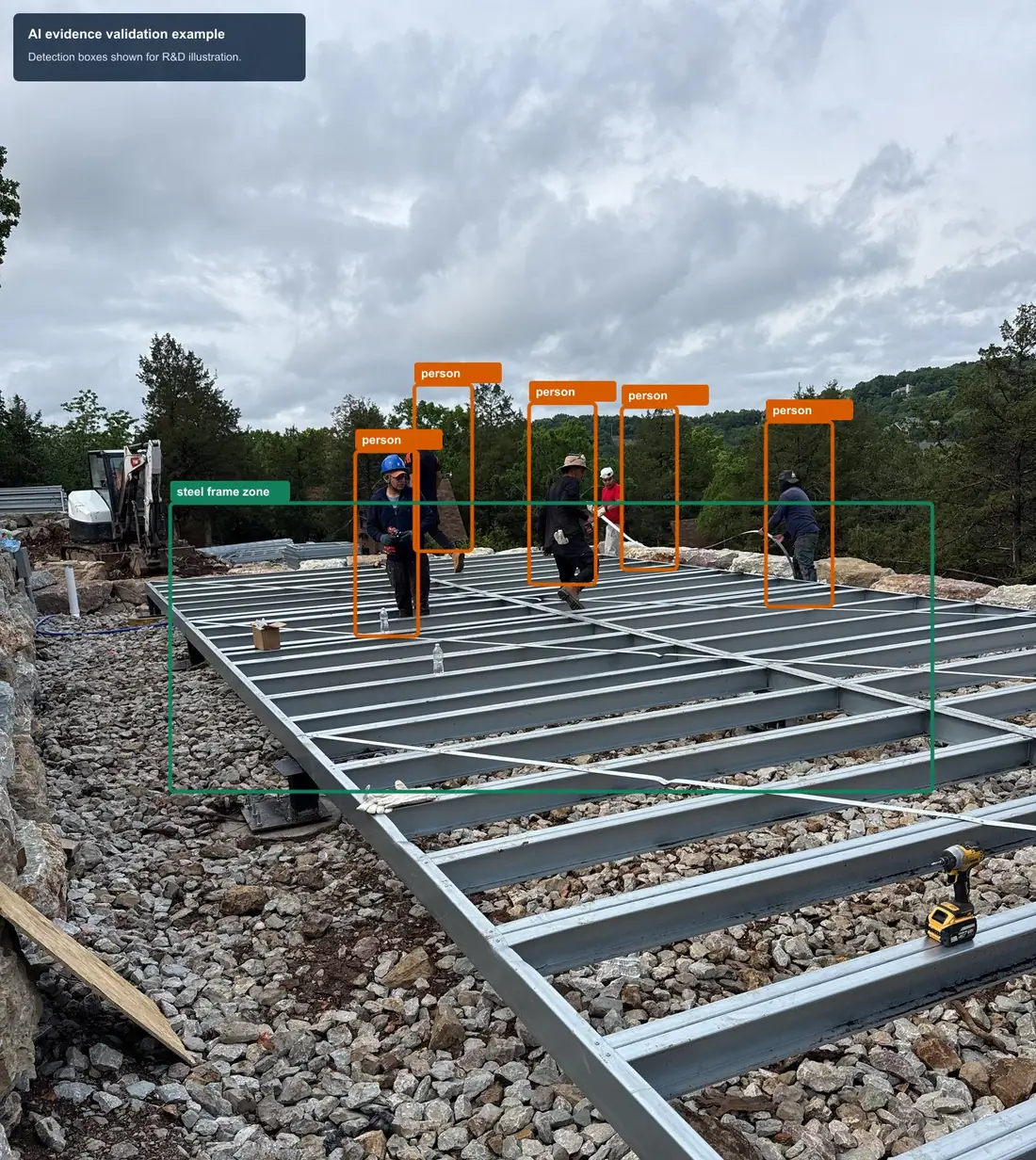
The latest prototype organizes AI review into layers. A hard-fact detection layer first identifies people, objects, and locatable targets. A vision-language model then produces a short structured fact card rather than a long generic description. When the detector and the vision model disagree, the system records conflict, confidence, and review status instead of forcing a false certainty.

Role summaries are built from the verified fact layer. A project manager, finance reviewer, or administrator should not receive freeform AI speculation. Each role should receive a view grounded in observations that can be revisited.

Field photo with detection boxes illustrating people and steel frame zones for KK Field Logger AI validation
Visual validation example showing how field photos can be converted into reviewable observations. Detection boxes are illustrative R&D overlays.

Twenty Real Field Samples

The R&D center used 20 real project photos for the latest validation round. The photos include workers installing metal framing, team material handling, material staging, outdoor construction context, vehicles, tools, frame structures, foundation work, distance shots, partial occlusion, weak composition, and non-standard camera angles.

In this set, the visual fact card and people detector fully matched on 14 of 20 images. In more difficult scenes, such as partial occlusion, multiple people moving material, and distant work areas, the system was able to mark uncertainty and call for review instead of blindly producing a final answer. This is the important step: the goal is not an answer that merely sounds confident, but evidence that a manager can trust enough to review.

Field photo with illustrative detection boxes for people and material handling during KK Field Logger AI validation
Real field sites include occlusion, odd angles, moving materials, and imperfect composition. These are the conditions the R&D process is designed to handle.

Fifty-Dimension Field Analysis Direction

KK Field Logger is forming a multi-dimensional field analysis system for project managers. Instead of viewing only raw photos, a manager could review structured indicators such as visible people, construction activity, material state, tools and equipment, PPE cues, site cleanliness, progress evidence, quality exceptions, rework risk, material staging risk, receipt and site matching, GPS and project matching, uploader and activity context, customer-visible record filtering, and finance anomaly signals.

These dimensions are not meant to make the AI write more impressive prose. They are meant to help managers, administrators, and finance reviewers notice what matters faster.

Visible people
5, medium confidence
Activity
Steel frame work and site movement
Materials
Metal framing, tools, staged components
Review flag
Yes, because real field scenes include occlusion and partial views

Real Field Material, Not Lab Samples

The latest R&D cycle used real photos uploaded through the KK Field Logger ecosystem, not downloaded demonstration images. That matters because real field images are not clean AI test pictures. They contain backlighting, motion, distance, clutter, partial people, stacked materials, tools that can be confused with other objects, and site conditions that change throughout the day.

Material staging photo used to represent field evidence for KK Field Logger AI development
Material staging, site context, and incomplete views are part of the evidence problem the platform is designed to organize.

AI As A Second Set Of Eyes

K&K's position is clear: AI should not replace the project manager. It should help the project manager miss less, review faster, and keep better records. A busy site may produce dozens or hundreds of photos in a day. Manual review is necessary, but it is slow and easy to miss.

KK Field Logger aims to turn field data into structured evidence so managers can quickly ask who was on site, what work was visible, which photos matter, what may require review, which materials or receipts need attention, and which records belong in a project report.

Local AI Deployment Direction

The current platform direction includes local AI backends for vision models, language models, and vector retrieval. This allows field photos, project data, and finance signals to remain within a controlled enterprise environment when that deployment model is required.

Current R&D capabilities include local vision model access, AI queue processing, GPU resource monitoring, asynchronous jobs, AI report history, early Copilot question answering, receipt fact extraction, and multilingual interface foundations.

Independently Developed Field Evidence AI Architecture

KK Field Logger is a field evidence chain and AI review platform developed by K&K Data Service Inc. The company's core system work includes product design, business workflows, data models, permission structures, field evidence chain processes, layered AI analysis architecture, conflict arbitration logic, industry-specific prompt systems, report generation logic, and management-side user experience.

The system is built with appropriately licensed open source software, databases, container technologies, and local AI runtime components where they fit the engineering need. K&K Data Service respects third-party intellectual property and will continue reviewing open source licenses, model licenses, and commercial-use boundaries as the platform moves through development, deployment, and customer delivery.

The value of KK Field Logger does not come from a single open source model or general-purpose software component. It comes from K&K Data Service's own engineering integration across field data capture, evidence structuring, AI-assisted review, management decision support, and finance review workflows.

Next Stage: From Recognition To Review Loop

The next R&D stage will continue building a real field photo benchmark, improving people, material, equipment, and PPE detection, strengthening evidence gates, storing AI conclusions as queryable evidence observations, and making Copilot answer from the fact layer rather than from a single summary sentence.

The broader goal is to strengthen the decision outputs for project managers, finance reviewers, and administrators while building automatic reporting and exception alerting capabilities.

We are not trying to build an AI that writes essays about photos. We are building a system that helps companies understand field conditions, trace evidence, reduce missed details, and support management decisions.

KK Field Logger is turning field photos from static records into dynamic evidence. Every upload becomes a site record. Every AI analysis becomes a management review. Every structured observation can become part of the project, risk, and finance control loop.