
KK Modular AI R&D Center advances an AI-assisted modular housing workflow.
From plan interpretation and steel frame logic to BIM-ready data, automated model checking, kit staging, logistics planning, and cost modeling, the team is developing modular housing as a calculable industrial product.
R&D Model
Steel frame, wall, BIM, kit, and cost logic are being organized into one reviewable design workflow.
This is a public R&D update. Final structure, code compliance, pricing, permits, logistics, and installation scope require project-specific professional review.
KK Modular AI R&D Center has completed a staged integration of a new modular housing development workflow. The current work connects customer plan interpretation, structural logic, wall and MEP planning, BIM-ready data, automated model checks, container loading, field reassembly planning, and cost modeling into one reviewable process.
The goal is not simply to draw a house. The goal is to move modular housing from a static plan product toward an industrial product that can be calculated, checked, packaged, shipped, reassembled, and improved over time.
Starting From A Real Plan
The R&D workflow begins with a customer-recognized base plan. Layout, room relationships, window and door positions, heights, and major functional intent are treated as source inputs rather than freely reimagined. This helps preserve the practical value of the original home design while making the model suitable for further engineering review.
In the current R02 reference model, the team has organized geometry, structure, wall systems, MEP routing assumptions, container loading logic, and cost data into a connected development chain. That model is now being used as a repeatable sample for refining the broader product workflow.
Integrated steel frame, wall, door, and window view used during modular housing design review.
Steel Frame Logic For High-Wind Design Direction
For high-wind application scenarios, the R&D direction studies a 200 MPH design target as an engineering objective, not as a public certification claim. The current strategy is not to add steel blindly. It is to organize the structure around clear load paths, defined openings, connection zones, and reassembly logic.
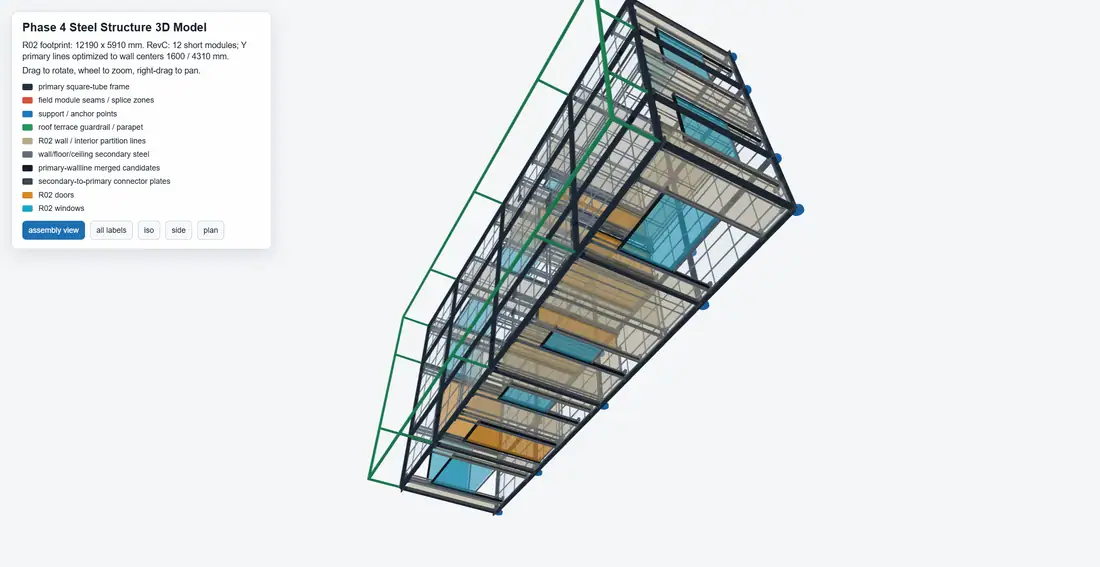
The reference workflow uses HSS main frame members for the primary load path, C/U type secondary framing for walls, floors, and roof support, reinforced door and window openings, diaphragm-style roof and floor thinking, and defined anchor and connection locations. The design package is also being shaped so factory drilling, welding, numbering, and prefit checks can support a more predictable field reassembly process.
Structural review view focused on reducing door and window conflicts while keeping the load path readable.
From Load Items To Stage-Ready Kits
One of the most difficult parts of modular housing is not taking a house apart. It is putting it back together accurately, quickly, and with limited field confusion. The current R&D model has organized 561 load items into 159 stage-ready kits for review.
Those kits are grouped by installation phase, structural zone, wall cassette, MEP interface, floor and roof layer, connection hardware, and access panel area. The intent is to move complex judgment into the factory and design package, while giving the field team a clearer installation sequence.
Steel members can be grouped by installation order. Wall cassettes can be delivered as sets. Fasteners can be packed by node. MEP interfaces can be concentrated in service zones. Finish panels and access panels can be kept away from structural conflicts. Floor and roof finish layers can remain loose-packed where that reduces transport damage.
Lightweight BIM And Automated Model Checking
The R&D center has also built a machine-readable inspection package for the reference model. The data includes component IDs, bounding boxes, centerlines, component types, system ownership, connection nodes, allowed overlaps, access areas, and container-loading context.
That means the model can be reviewed by people and checked by software. Current automated checks cover collision review, floating wall conditions, duplicated wall logic, door and window conflicts, whether MEP routes enter planned chases, whether access panels cover service zones, whether nodes are reachable, whether fasteners intrude into finish areas, and whether load dimensions follow 40HQ container logic.
Side view used to review structure, wall zones, openings, and service access assumptions.
Wall, Insulation, Finish, And MEP Systems Together
The current base configuration studies an Economy+ direction rather than a luxury-only specification. It uses MgO board as a substrate or structural sheathing layer rather than a final decorative surface, interior PVC/WPC/wood-look finish panels, rock wool for insulation and acoustic control, metal exterior finish over WRB and MgO layers, and a roof terrace direction using TPO waterproofing with removable WPC deck boards.
MEP rough-in is treated as part of the product logic. Key interfaces are kept serviceable, access areas are protected, and the design does not assume that every component should be sealed permanently in the factory. The development principle is simple: complete factory-suitable work in the factory, while preserving the access needed for inspection, testing, and future maintenance.
Node package example used to connect design data with field assembly instructions.
Cost Modeling Before Deposit Decisions
The R&D center is also testing a V4 cost model so early budget conversations do not depend on a single guessed total. Each cost node is connected to quantity source, quantity formula, price source, evidence level, included scope, excluded scope, dependency, and risk sensitivity.
For the current R02 reference model, the pre-deposit planning logic includes internal reference figures for factory goods and services, ocean freight, U.S. installation labor, and tariff sensitivity. These figures are not public fixed quotes and do not include project-specific foundation, permit, site access, utility, engineering, or jurisdictional requirements. Their value is to help customers understand whether a budget direction is realistic before moving into deeper RFQ and engineering work.
Factory Planning And Field Reassembly
The product direction remains clear: use organized factory work to reduce field uncertainty. The current factory planning model includes a 25-working-day factory schedule, 12 WBS work packages, steel receiving, cutting, drilling, welding, test fitting, numbering, wall cassette production, MEP preassembly and testing, floor and roof pre-cutting, disassembly, packing, photo records, and a 2x40HQ loading baseline.
As this workflow matures, modular housing can move further from a one-off construction event toward an industrial product system. The same base process can support additional layouts, configuration levels, supplier feedback, engineering review, installation feedback, and future automation.
Building A Modular Housing R&D Foundation
The work now being organized by KK Modular AI is not a single house model. It is a development foundation: plan interpretation, steel structure logic, lightweight BIM, automated inspection, stage-ready kit planning, factory PM organization, cost modeling, RFQ evidence, customer budget state logic, and review packages for human designers and engineers.
The long-term direction is to let the house become data first, then a model, then a checked component system, then a container-ready kit, and finally an industrial product that can be reassembled with more confidence on a remote site.