AI Data Center Design and Construction: A Coordinated Reference Drawing Set
AI data center design is a density problem before it is anything else. This page walks the design consequences of 136 kW liquid-cooled racks through the electrical, structural and network disciplines — and links the full free drawing set that documents them.
How an AI Data Center Differs from a Cloud Data Center
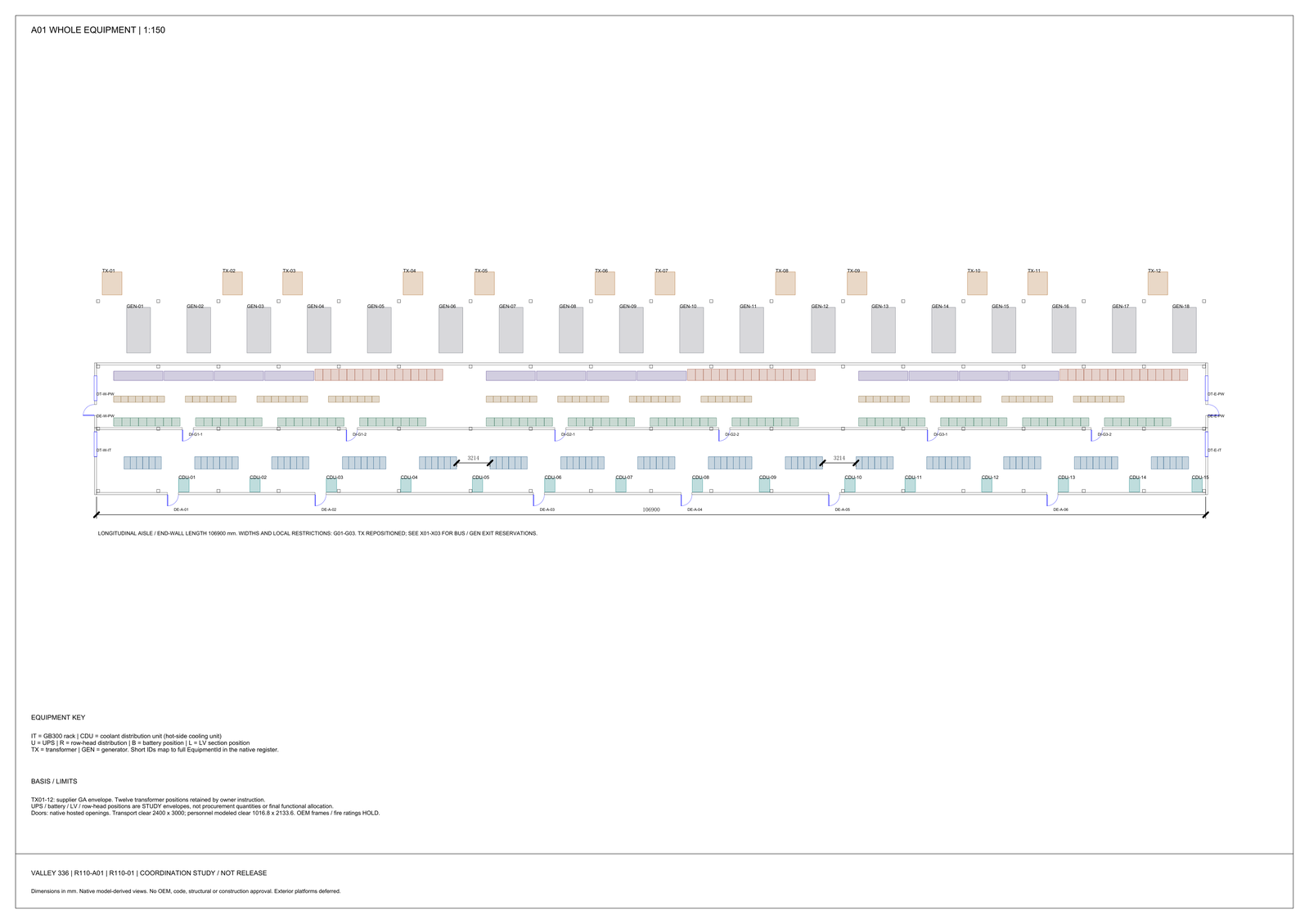
The difference is not the servers; it is the density. A conventional enterprise or cloud hall is designed around roughly 5–15 kW per rack, air-cooled. The AI data center documented here is designed around 136 kW per rack, direct liquid cooled, ~1.4 tonnes per rack — roughly a ten-fold jump in power and heat per floor tile. That jump propagates through every discipline: electrical blocks grow to multi-megawatt zones on independent power paths, cooling moves from air handlers to coolant distribution units piped to every rack, the floor and steel system must carry continuous rows of ~1.4 t racks, and the network becomes a dense hall fabric sized for GPU cluster traffic.
What “AIDC” Means Here
AIDC in this context is the industry abbreviation for AI data center — a facility purpose-designed for AI training and inference load. (The same letters are used elsewhere for “automatic identification and data capture”; that industry is unrelated to this site.) The AIDC reference design published here is a coordinated three-discipline drawing set for a GB300-class GPU facility.
The Three Disciplines That Must Agree
An AI data center design only works when the electrical, structural and network documents describe the same building. The published set is coordinated: the electrical drawing book (88 pages) carries 12.47 kV single-line diagrams and four-path distribution to 42-rack GPU zones; the structural set (170 pages) carries the design basis, prefabricated steel drawings and technical specifications for the hall that holds those racks; the network reference design (58 pages) defines the cluster topology and cabling that runs through the same rows. Equipment plans, CDU positions and rack rows appear consistently across all three.
From Design Toward Construction: Document Discipline
These are construction-drawing-style documents published at Design Development — Public Edition status: every sheet states its assumptions and open items, and every number in the accompanying 104-article Data Center Lab carries a maturity label ([FACT], [MODELED], [TARGET]) and a source. A construction issue would add what a public reference design cannot: an Engineer of Record seal, permit review, and site-specific utility coordination. Publishing the working record — instead of a gated whitepaper — is deliberate: we would rather be examined than take our word for it.
Download the Drawing Set
Every document is a direct PDF download — no registration, no email gate — with a published SHA-256 checksum on the downloads page:
- Electrical Drawing Book — PE-P1 (14 MB, 88 pages)
- Structural Document Set — Public Edition P1 (84 MB, 170 pages)
- GPU Hall Network Reference Design — PE-P1 (1.5 MB, 58 pages)
- All Three Disciplines — Combined ZIP (97 MB, 3 documents)
Published at Design Development — Public Edition P1 status: reference designs for study and evaluation, not construction issues, not sealed by an Engineer of Record. Reuse follows the attribution terms stated inside each document.
Common Questions
What does AIDC stand for?
In the data center industry, AIDC is shorthand for AI data center — a facility designed for AI training and inference workloads at high rack density. It is unrelated to the identically-abbreviated automatic identification and data capture industry.
What rack density should an AI data center design for?
Current GB300-class rack systems run on the order of 135–150 kW per rack, fully liquid cooled. The reference design on this site uses 136 kW per rack with A/B dual feed as its design basis — about ten times conventional cloud-hall density.
Are these actual construction drawings?
They are construction-drawing-style sets — single-line diagrams, steel drawings, specifications — published at Design Development — Public Edition status for study and evaluation. They are not issued for construction and carry no Engineer of Record seal.
Is the download really free?
Yes. Direct PDF downloads with published SHA-256 checksums, no registration and no email gate, from the downloads page.
Questions about any sheet or parameter: inquiry@kkdatasvc.com or the contact page.