
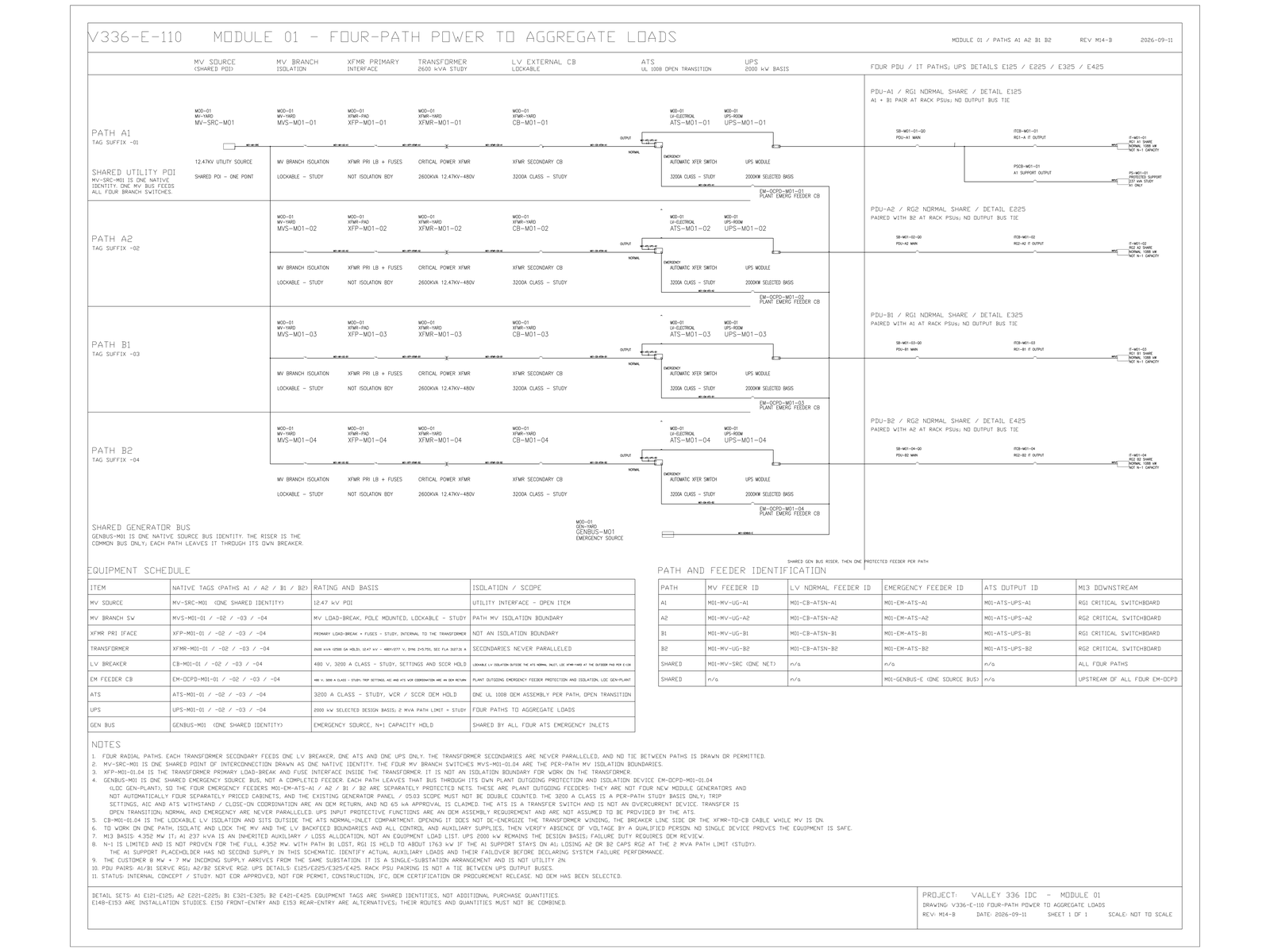
A load-allocation freeze for a 90-rack GPU hall replaced a 36-CDU cooling package with fifteen six-rack cooling units, each one duty plus one standby — 30 CDUs and 60 candidate dual power inputs [DESIGN]. The electrical frame it lands in was kept unchanged: 13 UPS paths (six in the 7 MW zone, seven in the 8 MW zone), 16 generators in four sections with three bus ties [DESIGN]. The freeze is an allocation and screening decision, not a procurement order and not vendor manufacturing data, and its most reusable outputs are two rules about which numbers move when a package changes.
The number that could not be multiplied
The retired package documented a whole-unit input ceiling of 63 kW per CDU. That ceiling was a design limit of the old 36-unit, 900 kW package — not a measured draw of the new six-rack duty — so the freeze refuses to multiply it by 30 and carry the product forward as the cooling load [DESIGN]. The old bill of materials goes the same way: pump models, ratings and standby counts from the superseded package do not migrate without vendor confirmation for the new unit [HOLD]. A package change is exactly the moment derived numbers die; the freeze's job is to say so in writing rather than let a familiar figure survive into the new arithmetic.
Why the survivor path counts two machines
On loss of one UPS output, rack IT load transfers along its existing dual-input assignments, and affected CDUs re-source to the surviving UPS through the manufacturer's own source selection — no added external transfer switches, and no paralleling of two UPS outputs [DESIGN]. The duty machine and the hot standby can both remain energized on that surviving path. The admission rule follows: the survivor must be screened for primary plus standby power, P + S, not for the running draw of one unit. And if the manufacturer's transfer sequence runs both pump groups simultaneously, that overlap — its power, kVA, duration and the thermal ride-through it buys — is declared as its own case, not absorbed silently into a steady-state P + S line [HOLD].
A separate rule keeps mechanical failure out of the electrical event: when a duty CDU fails mechanically, the standby takes the thermal load, and a zero in the event table means the failed machine is confirmed isolated — not "unknown, so zero." What this screening proves is that every cooling unit retains an energized path; it does not prove uninterrupted flow through the transfer [STUDY].
The admission arithmetic
Each UPS path is screened as
I_i = (IT_i + C_i + H_i + Lout_i) / eta_i + Qac_i
with C the CDU running-plus-standby electrical power, H the separately listed critical auxiliaries, Lout the downstream losses, and Qac the battery-recharge AC input, which is added after the efficiency division, not inside it. Anything counted inside C — internal pumps, drives, controls — may not appear again as a primary-side auxiliary, and each auxiliary lands in exactly one of H or the non-UPS mechanical bucket [DESIGN]. Site admission then requires
Σ I_i + M_nonUPS + Ldistribution + R_dynamic ≤ Σ q_online
where q is confirmed net output at site conditions, not engine count times nameplate [DESIGN].
Two rack comparison points bracket the screening [STUDY]: at 136 kW per rack, 90 racks put 12,240 kW of IT behind the UPS, an input floor of 12,618.56 kW at a flat 0.97 comparison efficiency; at 155 kW, 13,950 kW and 14,381.44 kW. Against fifteen generators screened at 1,000 or 1,100 kW net — two tiers kept because the original supplier figures conflicted — the remainders run from 618.56 kW to 3,881.44 kW, and those remainders must jointly cover CDU power, auxiliaries, distribution losses, recharge and dynamic margin. They are not a pump budget. With one UPS out, the general surviving path carries 1,428 or 1,627.5 kW of IT at the two comparison points, the worst paths 1,360 or 1,550 kW; against a 2 MW functional benchmark that leaves 372.5 to 640 kW, which must absorb C, H and Lout under the same event — maxima from different events are not added [STUDY].
One boundary the allocation does not close
The six-rack grouping runs R001 through R090 in sequence, and one cooling group spans the boundary between the 7 MW and 8 MW zones [DESIGN]. In-zone power allocation holding is therefore not the same statement as the thermal common-cause domain matching the IT power domain, and the freeze declines to claim that the new cooling topology adds no shared dependency. That claim waits for the primary-side equipment list [HOLD].
Limits and open items
Open with the CDU vendor: duty power P, standby power S, transfer-state power, power factor, start and transfer kVA, and maximum current per input at the new six-rack flow and temperature duty — the old 63 kW figure stands in for none of them [HOLD]. Open with the generator supplier: reconciliation of the 1,000/1,100 kW tiers to confirmed net site output, continuous-duty rating and step response [HOLD]. Open with the UPS vendor: confirmed continuous output of the candidate configuration, real efficiency curves, and enforceable recharge-current settings — the screening does not invent an energy-management limit the manufacturer has declined to support [HOLD]. Whether primary-loop pumps and controls require UPS backing depends on the flow interruption the thermal design can actually ride through, which is itself unconfirmed [HOLD].
No vendor data sheet, no field measurement and no acceptance test stands behind any number above; the table values are screening arithmetic on declared comparison points.
Closing observation
A freeze with this many HOLD labels can look premature. It is the opposite. By fixing the allocation rules — what counts as P + S, where each auxiliary may appear once, what the remainders must cover — before the vendor numbers exist, the freeze converts every outstanding quotation from a document to be interpreted into a short list of named quantities with prepared landing places. The five-item vendor-return list it produced is the whole point: when the numbers arrive, they drop into arithmetic that has already decided what it will and will not accept. The question worth asking of any package change is which inherited numbers the new design has explicitly killed — because any number not killed in writing will quietly multiply itself by the new unit count.
© 2026 K&K Data Service Inc. All rights reserved. Reproduction or republication is permitted only with clear attribution to K&K Data Service Inc. and a working hyperlink to the canonical URL of this article. Excerpts must preserve the technical context, maturity labels, assumptions, and limitations. No excerpt may imply project approval, field validation, certification, or endorsement that the original article does not state.
Source: K&K Data Service Inc., "A Surviving UPS Path Carries Primary Plus Standby CDU Power, Not One Unit," https://www.kkdatasvc.com/lab/electrical-architecture-and-failure-domains/a-surviving-ups-path-carries-primary-plus-standby-cdu-power/.
Discuss This Constraint. If your project record shows a different result, or the same failure domain under another name, we want to see it. Email inquiry@kkdatasvc.com or use the contact page.