
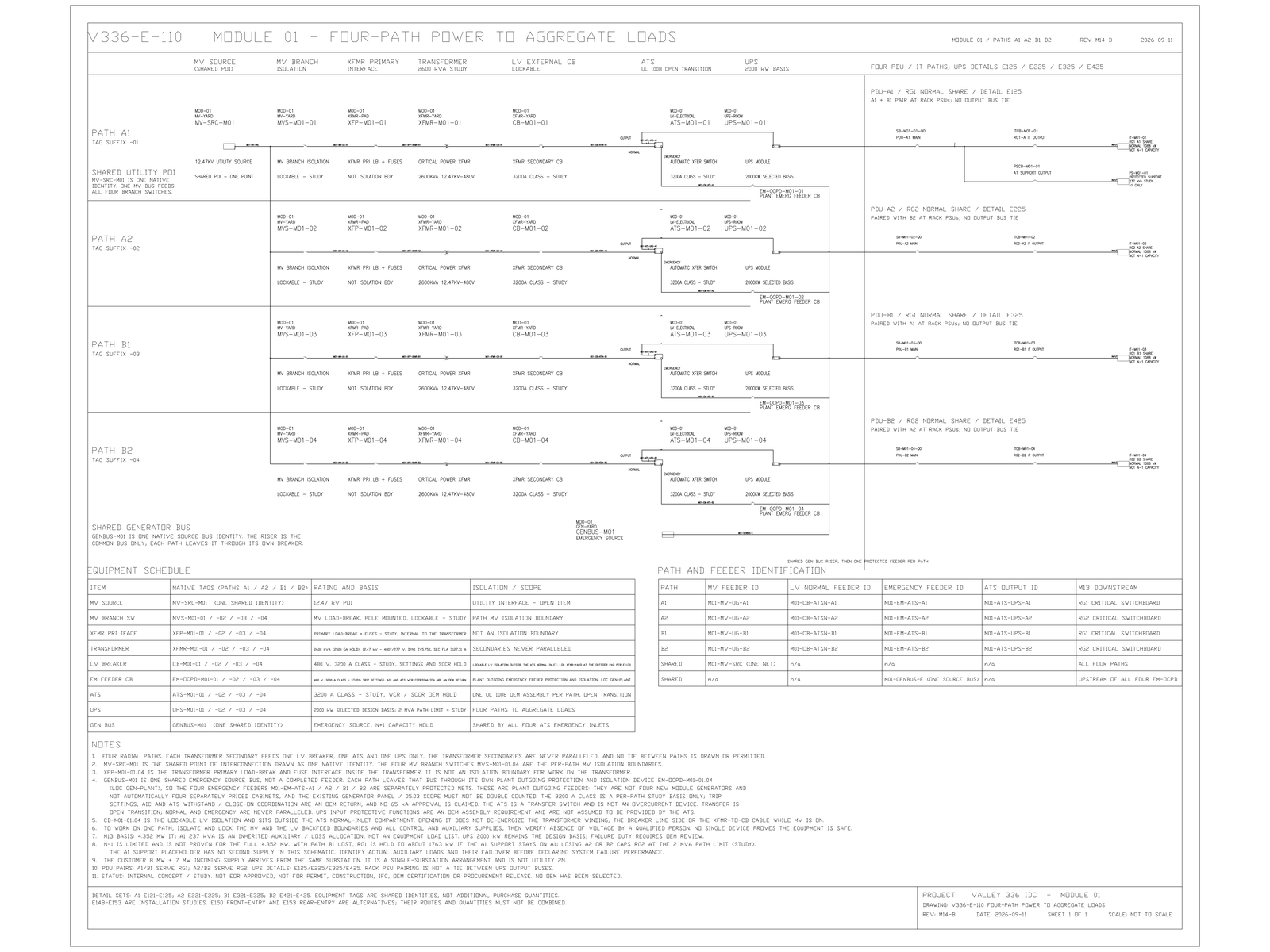
A secondary fault, an internal arc, or a bracing failure on one 480 V campus bus would take the entire protected load with it. The study tested that consolidation by division rather than by argument. At 12.711 MW [MODELED] of protected load and an assumed 0.99 [MODELED] power factor, a single three-phase 480 V bus carries 15,443 A [MODELED]. That current is about five times the largest device rating used anywhere else in the study. No bus product line reaches it. The figure covers the UPS-protected bus only. Mechanical and house load sit outside this denominator, so a literal whole-campus bus would be larger again.
Division Puts One Bus Far Beyond Any Catalogue Rating
The calculation is one line, taken in kilowatts over kilovolts so that it returns amperes directly:
I = 12,711 / (sqrt(3) x 0.48 x 0.99) = 15,443 A
Set that beside the ratings the rest of the design actually uses. A 2,500 kVA [MODELED] unit transformer's secondary full-load current is 3,007 A [MODELED]. A 2,000 kW [MODELED] UPS output is 2,430 A [MODELED]. Applying the 125 % [MODELED] continuous-load factor gives 3,038 A [MODELED], met by a 3,200 A [MODELED] frame or a 100 %-rated 3,000 A [MODELED] device. The consolidated bus is not a difficult version of an ordinary problem. At 5.1 times [MODELED] the unit-transformer secondary it is a different problem. The market does not sell the answer.
Bracing, Interrupting Duty, Arc Energy, and Failure Domain
Mechanical support is the first. Bus bracing is specified against prospective fault current rather than load current. A continuous rating of this magnitude still sets conductor cross-section, spacing and support pitch. There is no catalogue arrangement to specify against. The design would be a special at the single most concentrated point in the facility.
Interrupting duty is the second. A secondary fault at a single 2,500 kVA unit, computed on an infinite-bus assumption at 5.75 % [MODELED] impedance, gives 3,007 / 0.0575 = 52.3 kA [MODELED]. Low-voltage devices are therefore carried at an interrupting rating of at least 65 kA [MODELED], including a motor-contribution margin. The same record prohibits paralleling two transformer low-voltage secondaries. Doing so would push the requirement toward the 100 kA [MODELED] class. A single campus bus is that paralleling case by construction, across not two secondaries but all of them.
Arc energy is the third, and it is the one this note cannot quantify. Incident energy rises with available fault current and with clearing time. The medium-voltage side of the same study already requires arc-resistant construction on the explicit reasoning that a single lineup turns an internal arc into a site-wide event. The same reasoning transfers to a single low-voltage bus. No incident-energy calculation has been performed here. None is implied.
Failure domain is the fourth, and it survives every solution to the other three. If a 16,000 A [MODELED] product did exist and could be braced, specified and protected, one bus would still be one bus: the entire protected load behind a single fault location.
Sections instead of a bus
Critical low-voltage distribution is broken out per UPS module, one output section per module. That is stated in the record as the physical reason for the counting rule rather than as convention. The rule exists because the aggregate current does not exist as a product. Applied across the three studied topologies — 14, 12 and 8 modules of 2,000 kW [MODELED] — the section counts come out at 31, 27 and 19 [MODELED], with a critical-side frame rating of 3,000 A [MODELED]. One 15,443 A problem becomes seven to fourteen sections. Each of those stays under the 3,038 A continuous figure.
Limits and open items
Confirmed: the division is arithmetic and does not depend on equipment selection; paralleling two transformer low-voltage secondaries is prohibited on this record; the per-module sectioning rule follows from the current, not from preference. [FACT]
Modelled and unfrozen: 12.711 MW protected load, 15,443 A, 3,007 A, 2,430 A, 3,038 A, 52.3 kA, the 65 kA device figure, and the 14 / 12 / 8 module counts. The 0.99 power factor and the 5.75 % impedance are assumptions pending equipment data. The section counts are study quantities, not a bill of material. [MODELED]
Open and in one case blocking: the serving utility's system short-circuit contribution is unknown and is registered as a blocking item, so no interrupting rating can be closed. Device ratings await a power-system study under a licensed Engineer of Record. The end-use voltage decision is not made. No incident-energy study exists. [HOLD]
No figure here has been reviewed or sealed by an Engineer of Record. No equipment is released for purchase.
Neither Voltage nor Module Size Reverses the Sectioning
Two open decisions move the arithmetic. Neither reverses it. If the terminal voltage lands on 415Y/240 V rather than 480Y/277 V, the same protected load on one bus becomes about 17,864 A [SENSITIVITY]. The case against consolidation strengthens. If the module rating moves from 2,000 kW to 2,500 kW [SENSITIVITY], per-section output rises from 2,430 A to 3,037 A [SENSITIVITY]. The continuous factor then takes it to about 3,797 A [SENSITIVITY], which needs a 4,000 A [SENSITIVITY] frame. The sectioning conclusion holds. Every section rating in the count changes.
A genuine reversal needs the protected load itself to fall far enough for a standard rating to cover it. At 3,000 A that is about 2.47 MW [SENSITIVITY] — roughly a fifth of the current protected load. That is not a near-term possibility on any version of the load schedule now in circulation.
Which Other Aggregate Is Still in Megawatts, Not Amperes
The instructive part is not that 15,443 A is large. It is that the megawatt figure it came from looked entirely ordinary, and stayed ordinary through several document cycles, until somebody divided it by a voltage. Before the next single-line review, the question worth asking is which other aggregate on that sheet is still carried in megawatts and has never been converted into the unit the equipment is actually ordered in.
© 2026 K&K Data Service Inc. All rights reserved. Reproduction or republication is permitted only with clear attribution to K&K Data Service Inc. and a working hyperlink to the canonical URL of this article. Excerpts must preserve the technical context, maturity labels, assumptions, and limitations. No excerpt may imply project approval, field validation, certification, or endorsement that the original article does not state.
Source: K&K Data Service Inc., “A Single 480 V Campus Bus Would Be 15,443 A,” https://www.kkdatasvc.com/lab/electrical-architecture-and-failure-domains/a-single-480-v-campus-bus-would-be-15-443-a/.
Request the Public Calculation Note. If your project record shows a different result, or the same failure domain under another name, we want to see it. Email inquiry@kkdatasvc.com or use the contact page.