
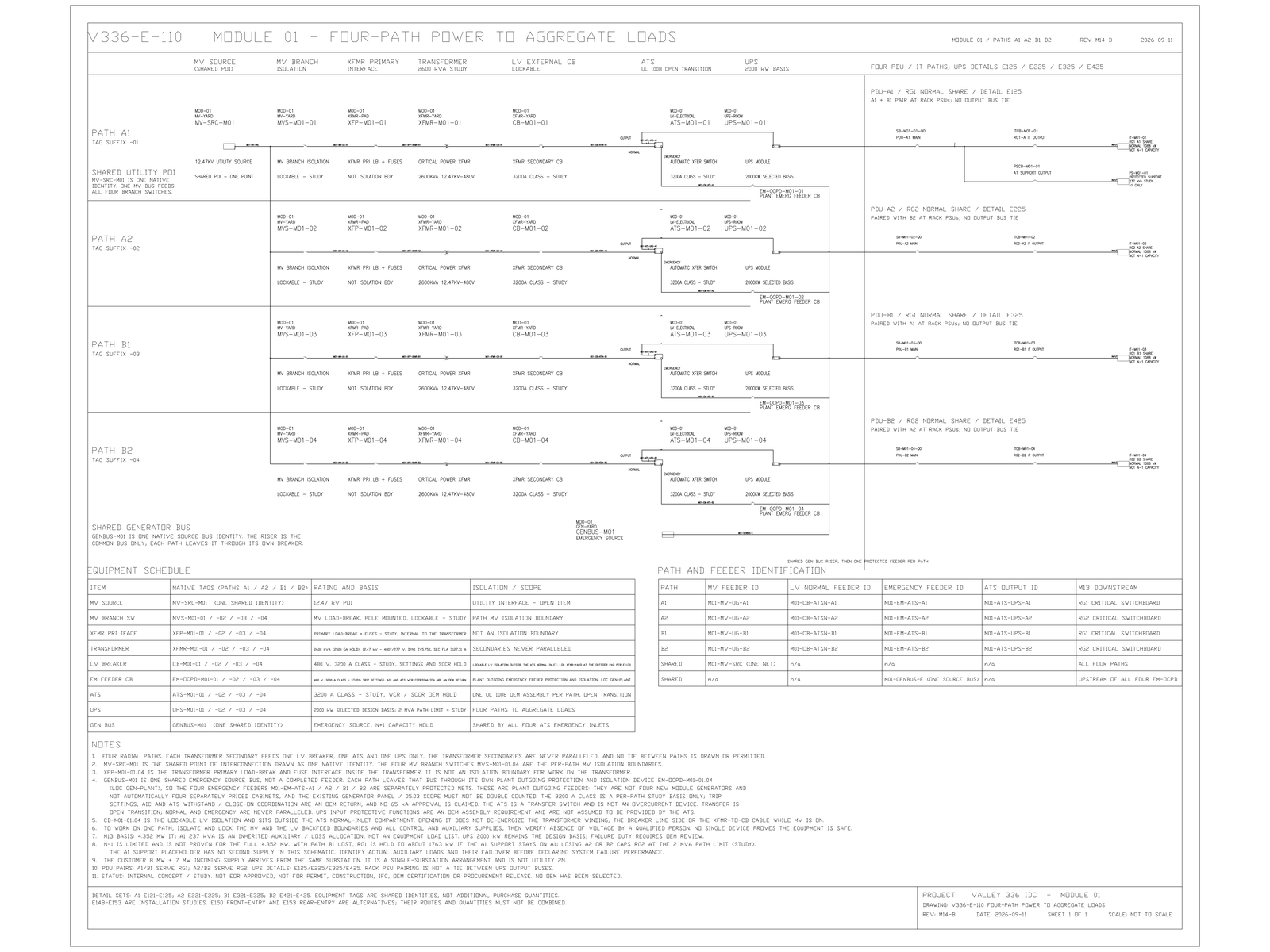
Trip the 8 MW [TARGET] feeder and 7.391 MW [MODELED] of the 14.391 MW [MODELED] facility demand has nowhere to go on the remaining utility service. Trip the 7 MW [TARGET] feeder and the leftover is 6.391 MW [MODELED]. In both cases the surviving feeder is not a second source of comparable standing. It is a partial source that keeps carrying what it was already carrying, and the gap is an entry condition for controlled on-site generation or load shed — not a transfer between two utility sources.
That classification stops at the utility interface. It says nothing about whether the generating plant will pick up in time, which is a separate question and still open.
A Transfer Needs a Second Source That Can Take the Load
A transfer implies a second source that can take the load. The architecture-decision record lists the contrary assumption among the simplifications that may not be used: do not assume the surviving feeder independently supports the whole site after single-feeder loss [FACT]. The Gate 1 closure record accepts the corresponding row: either feeder loss must enter generation or shedding, because 7 MW and 8 MW are both below 14.391 MW [FACT].
The two allocations already sum to the recorded 15 MW [TARGET] facility input cap. The surviving feeder cannot be grown into a full-site source on this record. Exceeding that cap is recorded as voiding the interconnection arrangement and forcing the medium-voltage and feeder design to be redone.
Getting the name right decides which document governs the event. Called a transfer, it belongs to the switching narrative and is closed out by a breaker sequence. Called a generation entry, it drags in the start chain, the paralleling or isolation decision, the load-shed table, the battery autonomy figure, and the cooling ride-through window. Every one of those has an open item attached to it on the current record.
Generation Must Pick Up Facility Demand, Not IT Load
Generation is carried as a site-level arrangement of eight units at 2.5 MW nameplate [TARGET], taken at 2.25 MW net per unit [MODELED] under an assumed 0.90 site derate [MODELED], with one unit spare. Seven running units give 15.750 MW [MODELED] against the 14.391 MW facility figure, a margin of 1.359 MW [MODELED], stated with battery recharge blocked until load is stable.
Both the derate and the recharge lockout are conditions of that margin rather than properties of the plant. The closure record expressly prohibits freezing the 0.90 derate. The N−1 generation figure holds only under those conditions, and with no large step load superimposed. Transient behaviour is unproven.
Generation answers to facility demand, not to the billable IT figure, because the load it has to pick up includes mechanical plant, house load, and the losses between them. Sizing generation by dividing the IT number into whole modules is listed as a prohibited shortcut in the same record [FACT].
Break-before-make
Paralleling on-site generation with the utility service is not available on the current record. The closure record prohibits any parallel arrangement before written consent from the serving utility, and the underlying quantity basis states that all of its arithmetic is executed on open-transition switching with no paralleling at any point [FACT].
What follows is a break-before-make sequence. Isolate the faulted section, then pick up. The surviving feeder may not be treated as a site source. Generation takes over the faulted section, or the site islands. The transferred load sees a real interruption, bridged on the electrical side by the UPS and on the cooling side by whatever thermal inertia the loop actually has.
Electrical and Thermal Ride-Through Run on Different Clocks
Those two bridges are not interchangeable, and the engineering record says so: battery minutes cannot substitute for liquid-cooling thermal inertia, and the thermal transient plus a joint integrated systems test are release conditions rather than assumptions [FACT]. A sequence that satisfies the electrical clock and misses the thermal one has not satisfied the event.
Failure of the first start attempt is registered as unproven. Coverage depends on the complete start chain being shorter than both clocks.
Limits and open items
Confirmed: neither surviving feeder supports the facility demand; assuming that it does is a prohibited simplification; parallel utility-generation operation requires written consent that has not been obtained. [FACT]
Modelled and unfrozen: the 7.391 MW and 6.391 MW gaps, the 14.391 MW facility figure, the 15.750 MW net generation figure and the 1.359 MW margin. The site derate, the auxiliary load allowance and the end-of-path loss allowance behind them are unverified inputs. [MODELED]
Open before the sequence can be written: the worst-case start chain, the first-start-failure branch, the step-load and paralleling model, a black-start integrated test, the serving utility's operating position, and a quantified cooling ride-through window. Utility-generation parallel operation, and the emission and rating regime for sustained single-feeder topping, may not be frozen. [HOLD]
No part of this has been reviewed or sealed by an Engineer of Record, no generator quantity is released for purchase, and nothing here reports how any plant behaved in operation.
Which gap the shed table is written against
The two gap figures differ by exactly 1.000 MW [MODELED] — 7.391 MW against 6.391 MW — because the allocations differ by 1 MW, and the same generation entry is invoked in both cases. That difference does not appear anywhere on a one-line, and it lands squarely on the shed table: a shed list sized to cover the larger gap also covers the smaller one, while a list sized to the smaller gap is 1.000 MW short in the other direction. Which of the two cases is your current shed table actually written against?
© 2026 K&K Data Service Inc. All rights reserved. Reproduction or republication is permitted only with clear attribution to K&K Data Service Inc. and a working hyperlink to the canonical URL of this article. Excerpts must preserve the technical context, maturity labels, assumptions, and limitations. No excerpt may imply project approval, field validation, certification, or endorsement that the original article does not state.
Source: K&K Data Service Inc., “Single-Feeder Loss Is a Generation Event, Not a Utility Transfer,” https://www.kkdatasvc.com/lab/electrical-architecture-and-failure-domains/after-one-feeder-trips-the-gap-is-a-generation-event/.
Discuss This Constraint. If your project record shows a different result, or the same failure domain under another name, we want to see it. Email inquiry@kkdatasvc.com or use the contact page.