
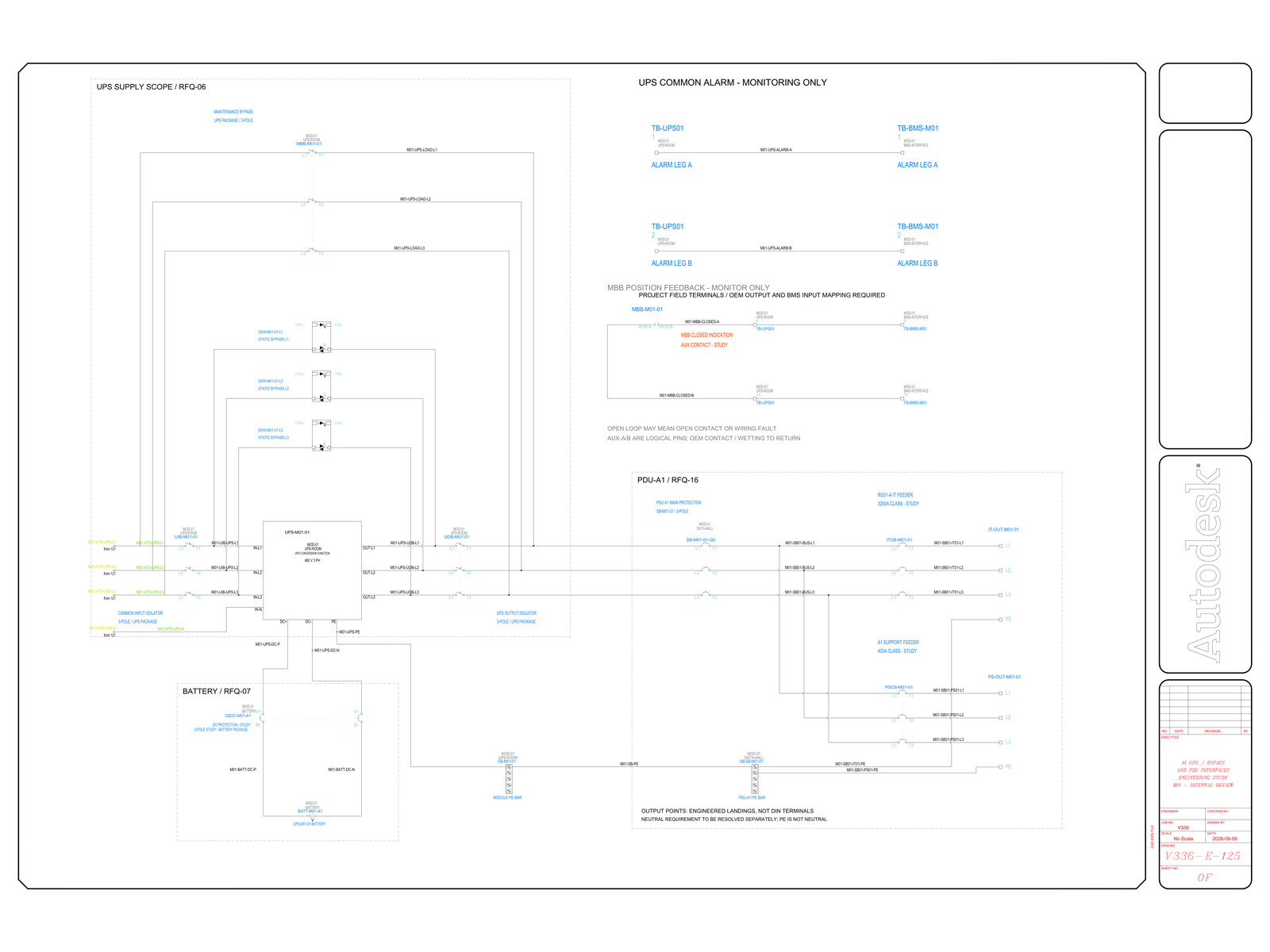
A plant with no utility, no uninterruptible-supply output, and no generator running is the case the bridging state assumed away. Recovery from that case requires the rectifiers to carry load and refill an exhausted battery at once. The highest-priority interlock forbids charging whenever a generator is carrying load. Both statements sit in the same controls basis, and the conflict between them has no resolution anywhere in the document set [TARGET].
The Restoration Machine Does Not Cover Black Start
The published restoration machine runs from normal utility through bridging, generator establishment, staged loading, stable running, transfer preparation, transfer execution and charge recovery, with a failure degradation state. An independent red team recorded a critical finding that this machine covers neither black start nor an island built on the remaining feeder. The bridging state silently assumes the uninterruptible supply still has output and the generator can receive a start command. Black start is the case where neither holds. The same red team re-confirmed the item open on its follow-up pass: a slot in the diagram, and no protocol behind it.
The controls author then added the missing branch as a named slot, not as a selected scheme. Its job is to make the energy questions askable. It is not a claim that the plant will run that way.
An earlier failure branch in the same chapter had assumed that battery exhaustion before the generator succeeds is terminal. Once a recovery path from that point is admitted, the recovery path is black start. That is how a branch closed by assumption reopened as an unresolved conflict.
Black Start Requires the Rectifier to Load and Charge Together
The heat-rejection chapter finds rectifier input at 82.3 per cent [TARGET] of the redundant generator rating of 15,750 kW [MODELED], against 12,968 kW [MODELED] of rectifier walk-in that cannot be applied in one step. The controls paragraph that reuses that result still writes the three mechanical stages as 6.0 per cent [TARGET]. The chapter it is quoting has since corrected that mechanical share to 900 kW, or 5.7 per cent [MODELED], after removing a 50 kW [MODELED] double count. Direction does not change. In an ordinary outage the rectifier is the sequencing problem. In a black start the same fact hardens, because the rectifier must carry load and simultaneously refill an exhausted battery, and refilling is precisely what the interlock exists to prevent.
The heat-rejection chapter never names black start. The conflict is new to the controls basis.
Neither Holding nor Releasing the Interlock Recovers the Plant
Hold the interlock and the battery never recovers, so the plant cannot leave the state it is in. Release the interlock and charging power is added at the most fragile moment the sequence has. Staged loading cannot arbitrate. The existing priority ladder assumes the uninterruptible supply is already carrying the protected load, and in black start that load is zero [TARGET] while rectifier inrush becomes the first and largest step.
The black-start sequence record carries its preconditions, commands, feedback, timeouts and safe states as unobtained items. There is no step timing to arbitrate with. Five energy questions are recorded open and entirely unobtained: generator starting-battery capacity and its charging source; fuel-transfer-pump supply; generator-controller and paralleling-panel control power; life-safety and security supply in that state; and who feeds all four before the generator has established a bus. A blocking item forbids publishing any black-start step timing until the generator control manual, the starting energy scheme and the station service single line arrive.
The commissioning index writes a black-start scene that still injects the ordinary staged-loading order. That is the same ladder the controls basis says cannot be reused here. The scene is blocked until every acceptance criterion is frozen. It does not resolve the interlock.
The Delivered Matrix Has No Charge-Inhibit or Black-Start Row
The delivered machine interlock matrix has eight rows, all held for approval [TARGET]. The first row is a fire-alarm contact. None of the eight is the charge inhibit. None of the eight is a black-start exception. The conflict the controls basis registered has nowhere to sit in the file that was supposed to hold the protective layer.
The author did not invent an exception. The conflict was registered as a change request asking the controlling authority to add a black-start exception with its current-limit conditions under the interlock entry, and as a separate open item assigning the limit curve jointly to the engineer of record and the supply vendor. A black-start drill including the exception sits in the test matrix as not runnable. A hard-wired station-service permissive is carried as a conditional-branch control object, so the physical layer is reserved while the sequence is unwritten.
Limits and open items
Confirmed: the published eight-state restoration machine does not cover black start. [FACT]
The 82.3 per cent rectifier share and the 6.0 per cent mechanical share remain the figures the controls basis quoted [TARGET]. The 15,750 kW redundant generator rating, the 12,968 kW rectifier walk-in, the 900 kW and 5.7 per cent mechanical correction, and the 50 kW double count are study figures from the heat-rejection revision [MODELED]. The eight held matrix rows are a delivered register [TARGET]. Protected load at entry to the state is zero [TARGET].
Open: the five energy questions; the generator control manual, starting-energy scheme and station-service single line; the current-limit curve, owed jointly by the engineer of record and the supply vendor; the change request for a black-start exception. The black-start branch is a conditional slot, not a selected scheme. The drill is not runnable. Nothing has been sealed. [HOLD]
Name the Generator Starting-Energy Source
Answer the starting energy chain so that the generator can be started and its controls powered with no contribution from the main battery, and the conflict dissolves, because recovery then leaves the critical path out of the state and the interlock has nothing to compete with. Until that source is named, what the state machine has is a slot, a name, and a recorded open conflict.
© 2026 K&K Data Service Inc. All rights reserved. Reproduction or republication is permitted only with clear attribution to K&K Data Service Inc. and a working hyperlink to the canonical URL of this article. Excerpts must preserve the technical context, maturity labels, assumptions, and limitations. No excerpt may imply project approval, field validation, certification, or endorsement that the original article does not state.
Source: K&K Data Service Inc., “Black Start Needs Battery Charge While the Interlock Forbids It,” https://www.kkdatasvc.com/lab/controls-epms-bms-and-dcim/black-start-needs-charge-while-the-interlock-forbids-it/.
Discuss This Constraint. If your project record shows a different result, or the same failure domain under another name, we want to see it. Email inquiry@kkdatasvc.com or use the contact page.