
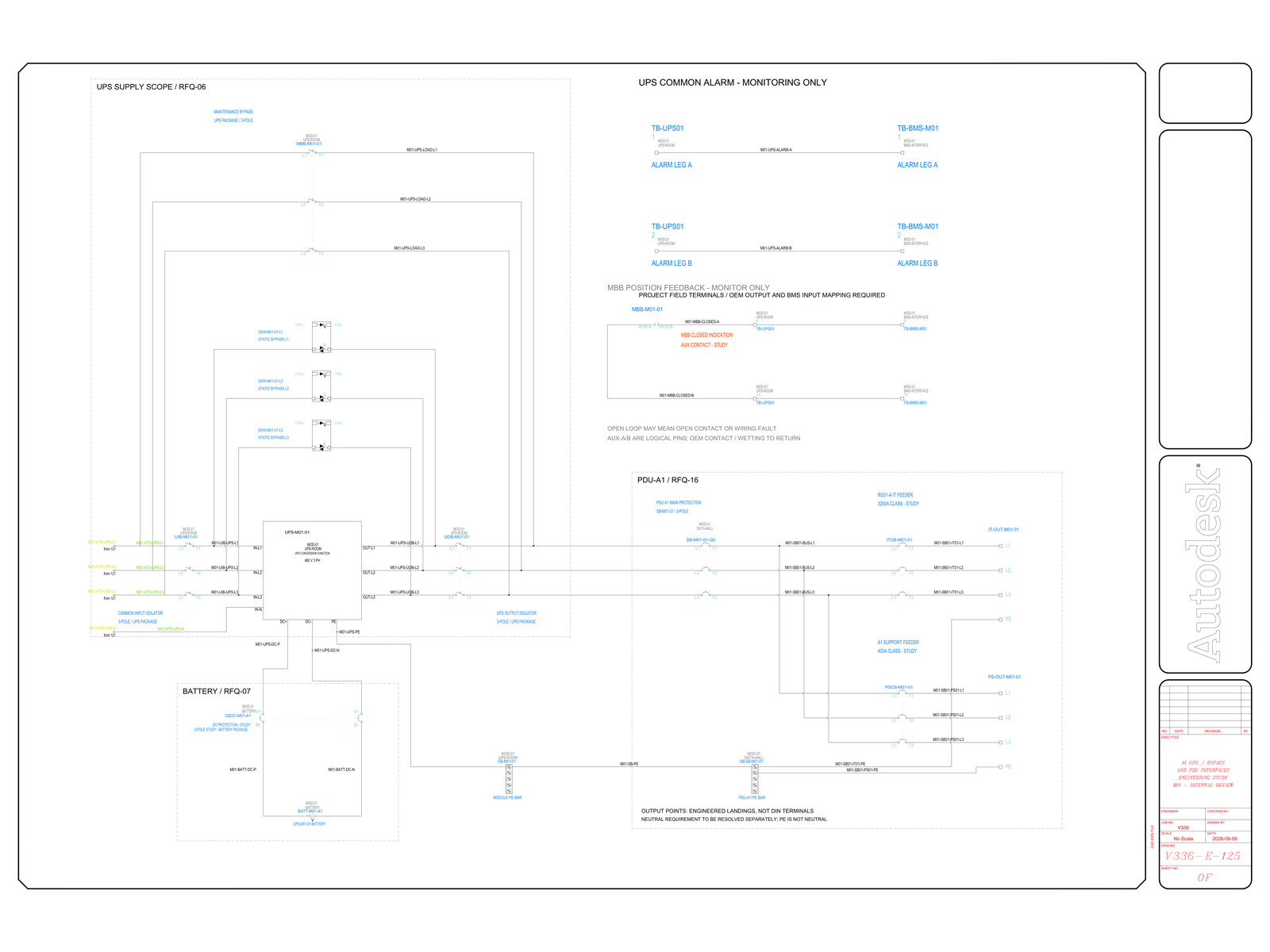
The first procurement revision wrote three controls packages onto one shared card. The later revision split them. The liquid-cooling sequence lot is the named example of the fourth splitting criterion: work that routine packaging would omit. It may not be folded into ordinary building-management scope. Three goods packages still supply the liquid-cooling plant [MODELED], and none of them supplies the layer above.
Three Controls Packages Were Split Off One Shared Card
The three goods packages are the distribution units with their secondary pumps, drives and local controllers; the primary pump set with its plate exchangers; and the heat-rejection equipment, itself three mutually exclusive route packages that may not be merged [MODELED]. Each carries its own autonomous control. Route switching, capacity sharing, zone set points and staging sit between all three.
The package file splits work on four criteria [TARGET]. The fourth exists for work that routine packaging would omit, and the liquid-cooling controls lot is its named example, with a mandatory clause that it may not be folded into the ordinary building-management scope. The distribution-unit card repeats the exclusion from the other side, listing the upper-level integration of that lot among the things the unit vendor does not supply. Every doubtful boundary in the file is resolved by an explicit in-and-out declaration on both cards, so that neither side can assume the other carries it.
The controls chapter states the separation a third time when it divides platform and engineering services from panels and hard-wired interlock terminals and from field instruments [MODELED], on the ground that integration responsibility cannot be transferred with equipment. The earlier revision had not merged the packages. It had written sixteen packages onto nine shared cards, so that the panel package and the instrument package had no independent quantity row and no independent close-out row [TARGET]. Directory presence is not a bid card. Adjudicate the integration boundary in favour of one supplier taking both the platform and the panel scope and the separation survives as an interface requirement while ceasing to be a separate tender. That is the single decision that would retire this finding.
No Equipment Vendor Supplies the Plant-Level Sequence Layer
The layer that gets orphaned is visible in the controls basis as a table column. Each equipment family is given autonomous content it keeps on its own, an interlock layer, and a supervisory layer holding the cross-equipment work: zone coordination and set-point dispatch for the distribution units, unit staging and differential-pressure control for the primary pumps, and the route-switching law and capacity coordination for heat rejection. Every entry in that third column is work no single vendor's scope reaches.
The hydraulic basis states the same gap from the equipment side. A distribution-unit controller keeps its own unit stable. It does not keep twelve units stable on one ring, hold a thirty-five per cent minimum-flow line, sample valve position back, or own the leak-response fork [MODELED]. None of those four items falls inside any equipment vendor's standard range. They are plant-level sequences. The heat-rejection chapter writes the complementary normal-run sequences as a structure that can move now, with every threshold still a placeholder. That catalogue is not the sixteen named sequences in the controls basis, and it is not the eleven delivered machine steps.
Interlock List and Loss-of-Supervision Must Precede Enquiry
Controls definition must precede equipment purchase orders, while controls completion must follow them. The hard-interlock list and the loss-of-supervision behaviour column have to be finalised before enquiries are issued, or they cannot become contract requirements at all. Every row of the loss-of-supervision column must become a mandatory enquiry question and a mandatory factory demonstration. A supplier answering that a behaviour is supported is not evidence. The behaviour has to be shown with the supervisory link disconnected and recorded.
Four Unfrozen Inputs Still Block the Sequence Lot
The lot carries four blocking inputs [TARGET]. The hard-interlock list is not frozen, and it determines the terminal-cabinet size and the safety-circuit form. The leak-interlock matrix is undecided, and it sets the boundary with the mechanical side and the actuator failure positions. The vendors' loss-of-supervision behaviour has not been collected; until it is, any statement that the system degrades safely on communication loss is an unproven assumption that may not enter a contract or a commissioning brief. The integration boundary itself is unadjudicated.
The lot is structurally defined and commercially blocked, and both statements come from the same card. The distribution-unit count is held at three parallel branches of eleven, twelve and fifteen units with none adopted [MODELED], and the heat-rejection route remains three parallel packages behind an unclosed equipment input. The result depends on those two adjudications in a way the controls lot does not, because the interlock list and the failure-behaviour table can be written against symbols now while a unit count cannot.
The delivered sequence file has eleven steps across five modes, all held for review [MODELED]: normal, failure, maintenance, restart and emergency stop. Timeouts on every row remain unobtained. None of those eleven is a dry-to-adiabatic-to-mechanical plant sequence. The file that exists is not the bid that is missing.
The same procurement file records that the single largest cross-package test burden is the end-to-end interlock verification running from this lot into the low-voltage transfer, the generators and paralleling panel, the fire-alarm system and all three cooling packages, item by item, named alongside the fire-alarm cause-and-effect matrix as one of the two heaviest hold points on the project.
Limits and open items
The hydraulic finding that the four plant-level items sit in no vendor's standard range is a recorded fact of the equipment chapter. [FACT]
The three goods packages, the three heat-rejection routes, the three controls packages, the eleven-twelve-fifteen unit branches and the eleven delivered steps remain study and register values [MODELED]. The four splitting criteria, the four blocking inputs and the sixteen-on-nine co-carding count are method and document-history figures [TARGET].
Open: the hard-interlock list, owed by the design side without waiting on any vendor; the leak matrix; written vendor behaviour on loss of supervision; the integration-boundary adjudication. The owner has one first action available. Freezing the interlock list is what turns the loss-of-supervision column into an enquiry question the market can answer. Nothing has been issued. Nothing has been sealed. [HOLD]
© 2026 K&K Data Service Inc. All rights reserved. Reproduction or republication is permitted only with clear attribution to K&K Data Service Inc. and a working hyperlink to the canonical URL of this article. Excerpts must preserve the technical context, maturity labels, assumptions, and limitations. No excerpt may imply project approval, field validation, certification, or endorsement that the original article does not state.
Source: K&K Data Service Inc., “Plant Liquid-Cooling Sequences Are a Separate Bid,” https://www.kkdatasvc.com/lab/controls-epms-bms-and-dcim/plant-liquid-cooling-sequences-are-a-separate-bid/.
Discuss This Constraint. If your project record shows a different result, or the same failure domain under another name, we want to see it. Email inquiry@kkdatasvc.com or use the contact page.