
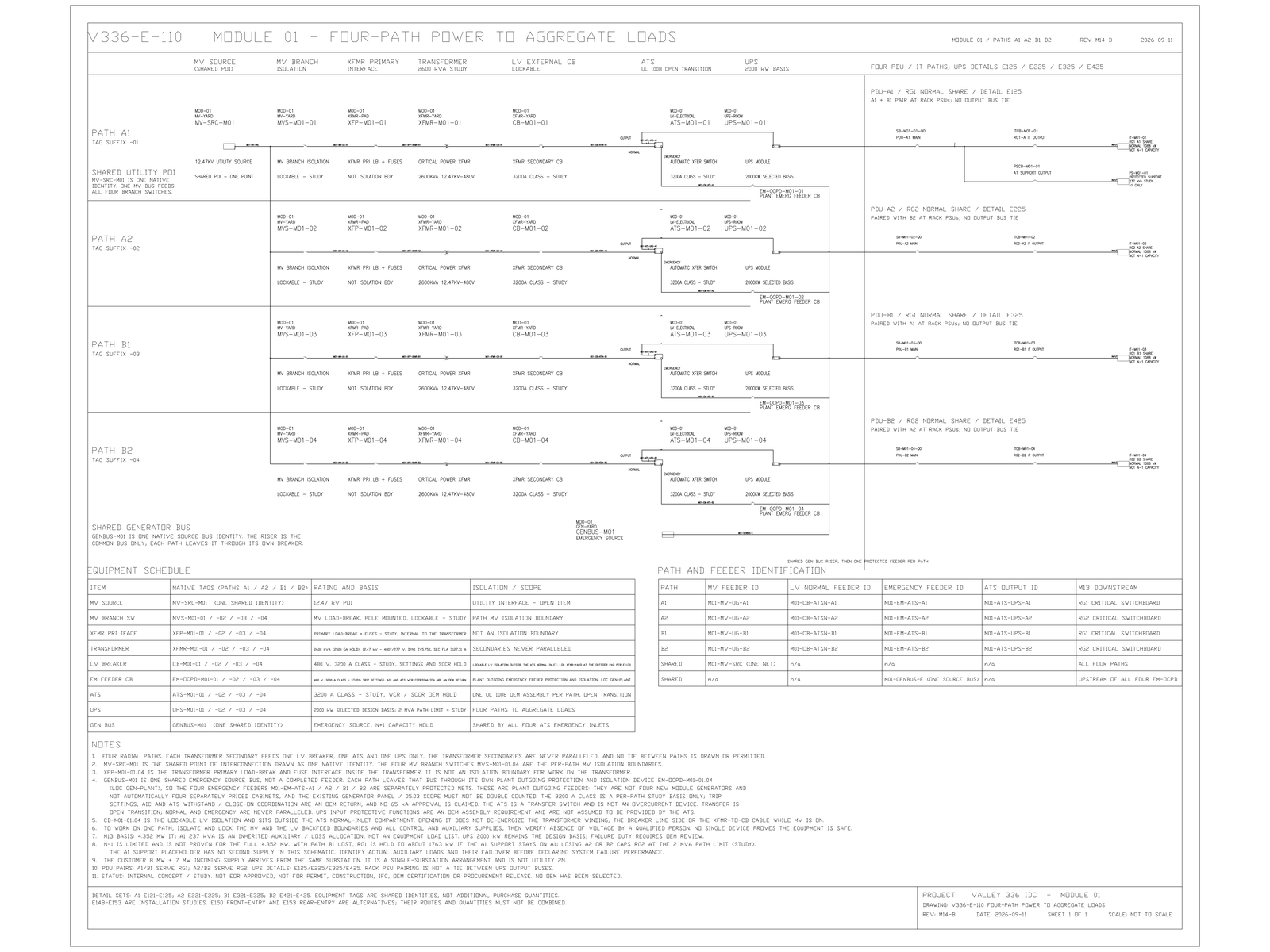
Twelve compartment candidates are listed. Six of them already sit in the must-not-merge tier [TARGET]. The electrical band is not among those six. It sits in the waiting tier, because whether it becomes a compartment at all is written as turning on occupancy and separation replies that have not arrived. The same page then proposes splitting that band by feeder side as a further must-not-merge candidate. Both incoming feeders originate at one substation. They are not an independent dual supply, and neither alone carries the facility [FACT]. Putting the downstream electrical equipment of both feeders inside one compartment would stack a second common cause on top of the first.
Two mechanisms are now in series [TARGET]:
- a shared origin, which removes independence at the source;
- a shared compartment, which would remove it again downstream.
A Feeder-Side Split Is Proposed as a Seventh Must-Not-Merge
The register grades compartment candidates on three tiers, and the top tier is defined without reference to any code: these are boundaries whose merger creates a single-point common cause, and the register holds that they should not be merged even where merging would be permitted. Because the tier test is a redundancy-topology test, the six can be put to the record engineer as design constraints now, while the code and authority questions behind the remaining candidates stay open.
The white-space floor in that set is already a lower bound: at least three white-space compartments [TARGET]. More is allowed. Fewer is a single dump or emergency-power-off across the information-technology load. Splitting the electrical band by feeder side is proposed as a seventh candidate for the same tier on the shared-origin reasoning. The register is careful to say it asserts an engineering consistency requirement and not a code requirement, which it has no standing to assert.
The middle tier is the one that waits. Whether those candidates become compartments at all turns on the occupancy classification and the separation requirement, and neither has been answered. The electrical band was listed there first. The feeder-side proposal is the later instruction on the same page.
Duplicating the MV Bus Moves the Failure Domain
Duplicating a shared medium-voltage bus in order to separate the two feeders' downstream equipment would move the failure domain instead of shrinking it, and the argument would return to bus identity, where the closure record already requires medium-voltage bus assignment to be decoupled from the low-voltage redundancy paths. That is the one ruling on the electrical side that defeats the compartment proposal.
The compartment count is the multiplier on almost every downstream fire quantity, and it scales them superlinearly [MODELED]:
- detection loops, which are forbidden from crossing a top-tier boundary and so increase with the count;
- suppression zones and their valve groups, tied to the compartment count where one zone serves one compartment;
- penetration seals, counted as the sum of crossings over every top-tier boundary.
No detection-loop count, valve-group count or seal count follows from any of this. The compartment count itself is a placeholder symbol until the occupancy and separation questions are answered, and the register says as much where it prints the expression.
Earthing Has No Penetration Type of Its Own
The bonding and firestopping basis takes that third term and finds a gap in it. Its penetration count expression sums six crossing types [TARGET], one of which it had to add itself: earthing and equipotential conductors. A continuous earthing system is the one system that must connect the plant. It therefore crosses more compartment boundaries than almost any other system. It was folded into the general electrical type, and so cannot be counted separately. The basis proposes adding the type instead of recounting the ledger, and submits that as a change candidate for the coordination function to rule on.
Both directions of failure are invisible. A missed seal around an earthing conductor leaves the earth connected and only the fire rating defeated. A seal installed by cutting the conductor because it looked like a stray wire leaves the rating intact and the earthing path broken. Neither shows up at any acceptance step.
The count of shared openings is the only term the designer controls with no external dependency, which is why the same basis proposes separating liquid and electrical penetrations at the routing stage as a decision available immediately. No party maintains that ledger today: its single maintaining party has not been ruled on, and its design responsibility field is blank.
Limits and open items
Confirmed: both incoming feeders originate at one substation; they are not an independent dual supply; neither alone carries the facility; a single feeder loss has to be met by generation or by shedding. [FACT]
Register figures, not compartments: the twelve candidates; the six already in the must-not-merge tier; the white-space lower bound of three; the two mechanisms in series; the six crossing types; and the superlinear multiplier on loops, valve groups and seals. None of the twelve candidates has been adopted. [TARGET] [MODELED]
Open: occupancy classification; separation requirement; whether the electrical band is split by feeder side; whether that split can be done without duplicating a shared medium-voltage bus; the earthing crossing type; and the ledger's maintaining party. Compartment boundaries and fire resistance can only be determined by the authority and the record engineer. Nothing here is a code requirement. Nothing releases a detector, a valve group, or a seal quantity. [HOLD]
Which Fire Takes Both Feeders' Downstream Equipment
The useful test is not whether the two feeders look redundant on the one-line. Name the single fire that takes the downstream equipment of both. If that list is empty, the second common cause is not on the drawing. If it is not empty, the first common cause already is.
© 2026 K&K Data Service Inc. All rights reserved. Reproduction or republication is permitted only with clear attribution to K&K Data Service Inc. and a working hyperlink to the canonical URL of this article. Excerpts must preserve the technical context, maturity labels, assumptions, and limitations. No excerpt may imply project approval, field validation, certification, or endorsement that the original article does not state.
Source: K&K Data Service Inc., “Two Feeders in One Fire Area Is a Second Common Cause,” https://www.kkdatasvc.com/lab/fire-structure-site-and-compliance/two-feeders-in-one-fire-area-is-a-second-common-cause/.
Discuss This Constraint. If your project record shows a different result, or the same failure domain under another name, we want to see it. Email inquiry@kkdatasvc.com or use the contact page.