
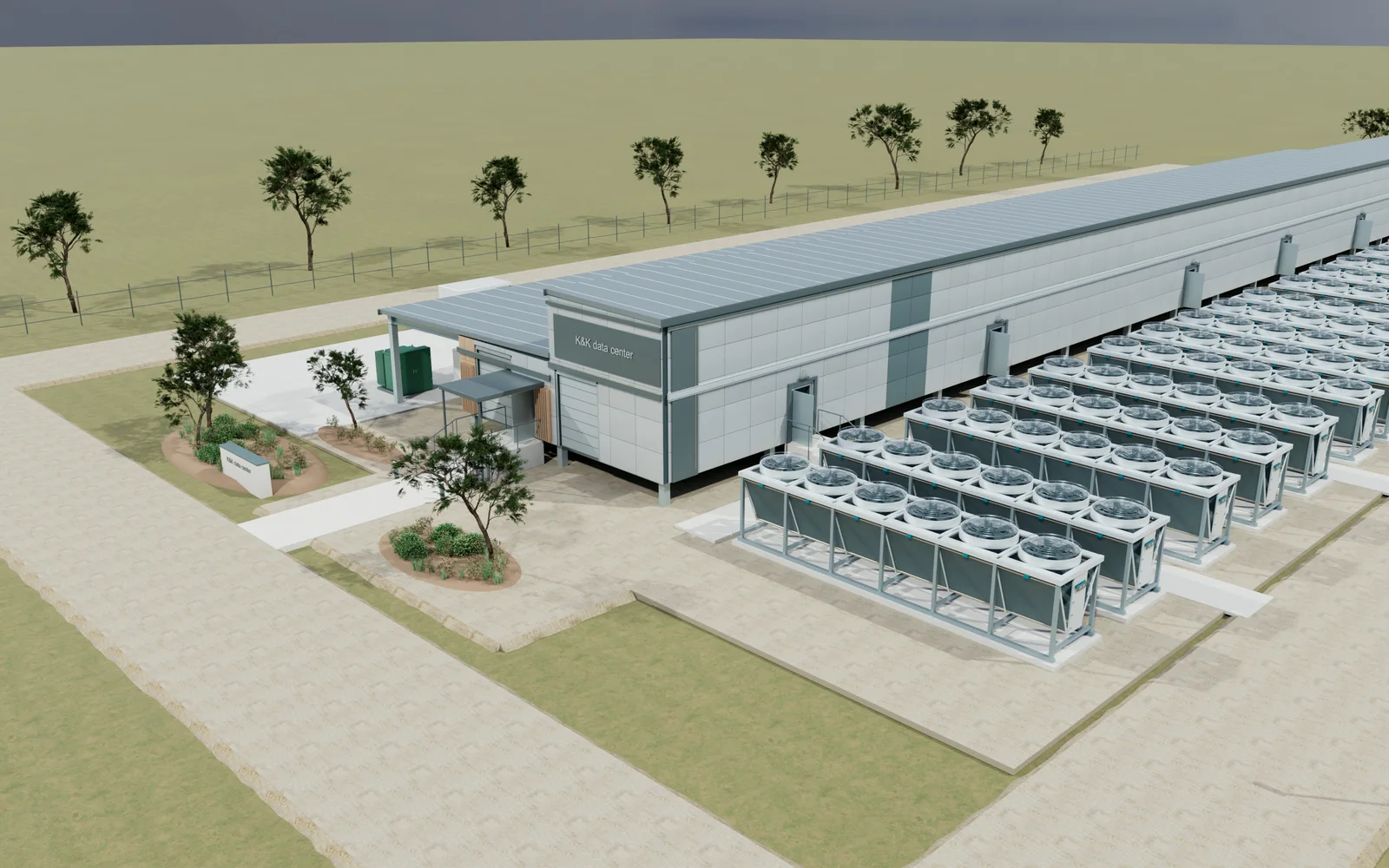
Status: designed, not built
The picture above is a rendering from the public 3D scene, not a photograph. The drawings are at Design Development — Public Edition: for study, not issued for construction, no engineer’s seal. K&K does not publish the site location. GB300 is a product of NVIDIA Corporation; K&K is not affiliated with NVIDIA.
The design in numbers
- IT load. 90 racks at 136 kW per rack: 12.24 MW, in two GPU zones.
- Service and transformers. 12.47 kV service; one 2500 kVA transformer per power path, 12.47 kV to 480Y/277 V.
- UPS. 13 UPS paths, six in one zone and seven in the other, 2 MW design duty per path. The UPS outputs are not paralleled. Every rack and every coolant distribution unit has two inputs.
- Generators. 16 generators of 1 MW in four sections.
- Cooling. Direct liquid cooling on a closed loop of 25% propylene glycol, 90 racks in five groups of 18. The cooling is sized on a heavier basis than the electrical set: 155 kW sustained per rack, 13.25 MW of liquid heat load.
- Water. Dry coolers carry normal duty, so normal operation evaporates no water. Wet assist is an exception mode for sustained heat or a dry-cooler outage. The first coolant fill is about 30 tonnes, delivered premixed, once.
- Building. A prefabricated steel building designed for rows of liquid-cooled racks at about 1.4 tonnes each.
- Network. A 90-rack GB300 NVL72 cluster: GPU hall topology, cabling and a storage-access model.
Each figure is a design basis or a modeled value, not a field measurement. Every number with its source sheet.
What K&K has published from this project
- Four drawing books, 408 pages. Electrical 108 pages, structural 187, network 75, liquid cooling 38. Free PDF, no account required, a SHA-256 checksum for every file. Download the four books.
- 45 drawing sheets, explained device by device. Reference designs, sheet by sheet.
- 108 technical articles on the electrical architecture, UPS sizing, liquid cooling, hydraulics and model checking. Data Center Lab.
- Two DOI-registered preprints by Rui Liang, on the water use of the dry-cooled design and on storage-access capacity in the cluster network, with code that reproduces the published dataset.
- The 3D scene of the building and cooling yard. 3ds Max source and renders.
The books are revised in public. In October 2026 a reader on r/HPC marked up the first network edition and flagged an optical cabling risk and missing storage paths; the second edition adds a storage-access model and optical-channel checks.
Who does what when it is built
K&K is the owner and developer. K&K holds no engineering registration and no electrical contractor license, so here, as on any site, an Engineer of Record seals the construction documents and licensed electrical contractors install the power. Mechanical and refrigeration work that requires a state license goes to license holders. The trades K&K’s own crews self-perform are site and civil work, concrete and transformer foundations, steel erection for prefabricated building systems, and freight, rigging and equipment setting. Every party a site of this size needs, in order.
K&K’s finished work is a separate record
The jobs K&K has finished, 2023 through 2025, are bitcoin-mining sites in Texas, Mississippi and Arkansas, built for other owners. They are listed on the project record with what K&K did on each and how each ended.
Questions about the project or a sheet
Write to inquiry@kkdatasvc.com or use the project brief form. Rui Liang, Founder, reads every message and replies.