
What 5–20 MW means in racks
At 136 kW per liquid-cooled rack, 90 racks draw 12.24 MW of IT load. That is the size of the GB300-class project K&K is developing for its own account: 12.47 kV service stepped to 480Y/277 V, 13 UPS paths, a 16-generator plant, direct liquid cooling on 25% propylene glycol. It is designed and not yet built. The four drawing books (408 pages) are public, so the scope behind each party below can be read sheet by sheet. GB300 is an NVIDIA product; K&K is not affiliated with NVIDIA.
The parties, in the order they are engaged
- Owner or developer. Controls the land, signs the power agreement, arranges the money and the GPU supply, and hires everyone else. On a small site the owner often also acts as developer.
- Utility. Studies the service request and fixes the point of delivery, the voltage, the capacity and the date. Texas Senate Bill 6 (2025) set a default threshold of 75 MW for its large-load interconnection standards; a 5–20 MW site is below it and is handled with the local transmission and distribution utility, cooperative or municipal utility. The load is submitted as separate numbers: IT load, UPS-protected load, total facility demand, and the service ceiling.
- Engineer of Record. A licensed professional engineer who seals the design. Anything on site that changes the design goes back to that engineer.
- General contractor or construction manager. Holds the prime contract, the schedule and the subcontracts when the owner does not hold them directly.
- Licensed electrical contractor. Installs the power. In Texas, electrical contractors are licensed by the Texas Department of Licensing and Regulation.
- Mechanical contractor and liquid-cooling supplier. Heat rejection plant, coolant distribution units, the secondary loop to the racks, coolant fill and flushing. Work that requires a state mechanical or refrigeration license is done by license holders.
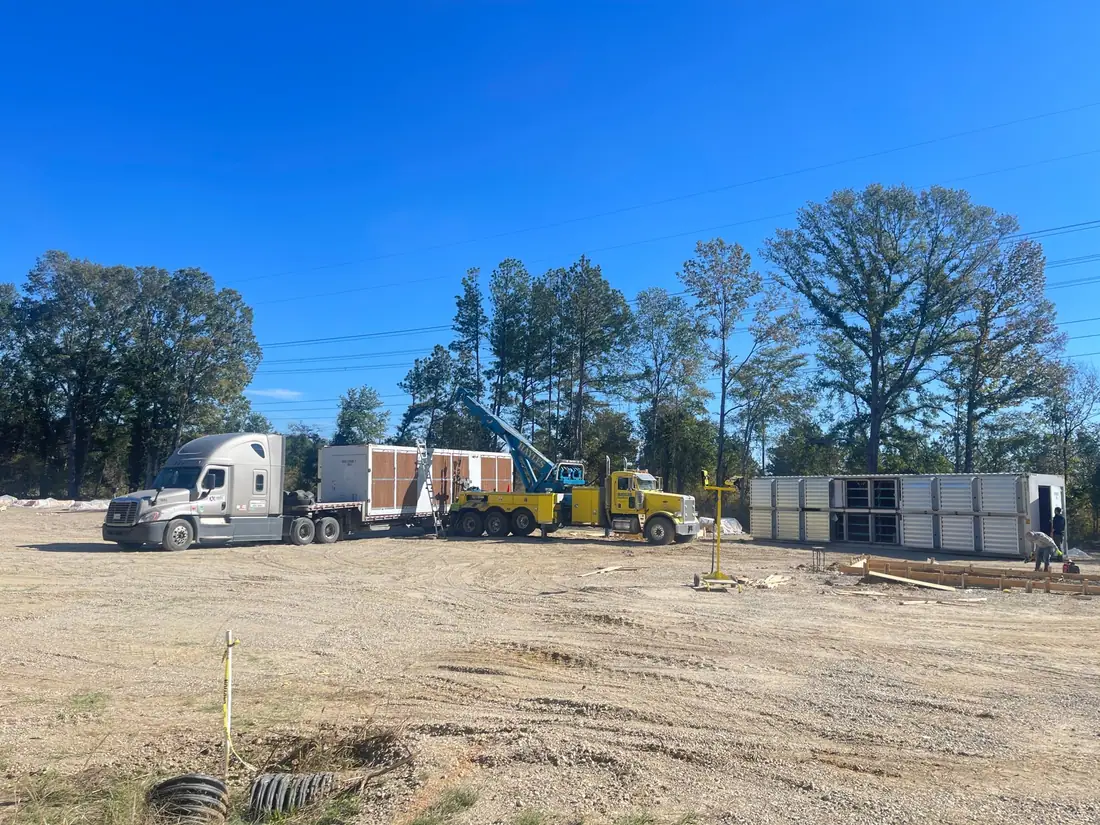
- Field crews for site, foundations, steel and rigging. Grading, drainage and roads; equipment and transformer foundations; erection of the prefabricated steel building; receiving, lifting and setting transformers, generators, switchgear and cooling equipment.
- Commissioning. Factory tests, site tests and the integrated systems test before the hall carries load.
Which of these K&K is
- Field crews (party 7), with its own people and equipment. Site and civil work, concrete foundations including transformer foundations, steel erection for prefabricated building systems, freight, rigging and equipment setting, and retrofits inside live facilities. Each trade in detail.
- Site direction for an owner. A site lead runs work zones, crews, equipment movements and safety coordination every day, coordinates with the utility and the county, and keeps the installation record.
- Developer (party 1) of its own GB300-class project. K&K develops that project for its own account and publishes its reference design. The project in numbers.
K&K is not the Engineer of Record and not the electrical contractor. It holds no engineering registration and no electrical contractor license; on a job, licensed electrical contractors install the power and the Engineer of Record named in the project contract seals the design.
K&K’s field record
The finished jobs, 2023 through 2025, are bitcoin-mining sites in Texas, Mississippi and Arkansas. At Bowie, Texas (20 MW, 2025) K&K did the site work, roads and water systems, transformer foundations, freight, receiving and lifting, about five months from foundations to handover, with electrical installation by licensed electrical contractors. What carries over to a GPU hall: site and civil work, transformer foundations, power-heavy logistics, utility coordination and work inside live facilities. What does not: an air-cooled mining machine draws about 3–4 kW; a GB300-class rack is about 136 kW and liquid-cooled. Each job in detail.
What to settle first
- Power before layout: the service request, the point of delivery and the energization steps fix where transformers, switchgear and generators sit. When power planning should start.
- The Engineer of Record before foundations: pad sizes, anchor patterns and equipment weights come from sealed drawings and vendor submittals.
- Access and receiving before equipment ships: truck and crane approach, laydown and setting sequence. Access planning.
Sending K&K a project
Send the site location, the power status, the equipment list and the date you need a crew. Rui Liang, Founder, reads every brief and replies: whether the scope fits, and a proposed call if it does. Project brief form.