
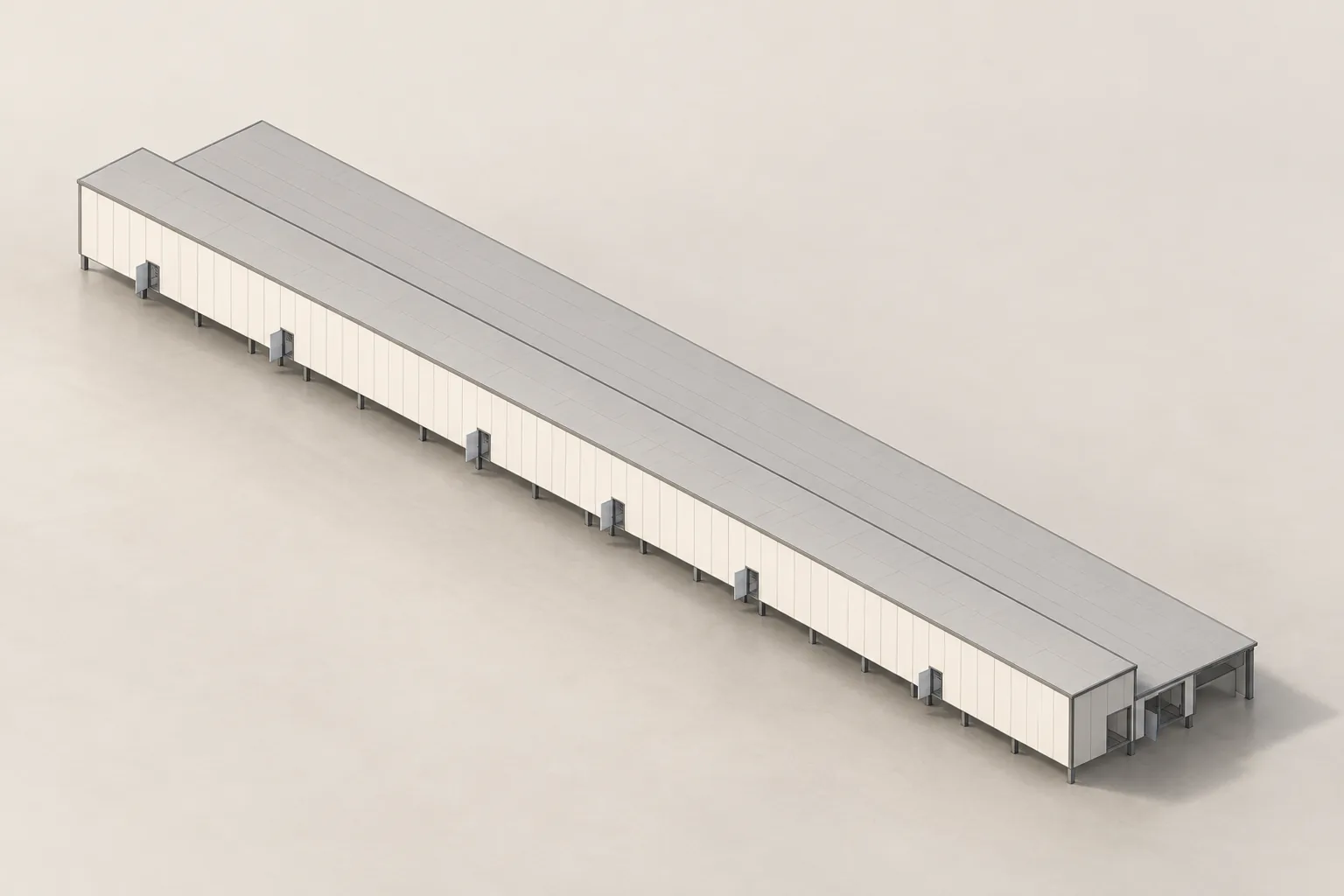
Two Revit files sit on the same project and they are not one model. The canonical file holds 573 objects and is not modified by this run [MODELED]. An isolated file holds 96 Electrical Equipment instances [MODELED]. An object count, a file digest or a machine PASS on one of them never proves the other. Ninety-six equipment instances were placed in the isolated file, and none of them is an electrical system.
Equipment Instances Do Not Carry the Circuit
Connectivity took two further object layers. One hundred and fifty-six connectors were generated to the actual degree each node carries. Seventy-eight system objects were created, one per edge, from an exact origin connector, each storing its own edge identifier [MODELED]. An independent read-only pass then confirmed four things at once: ninety-six devices, 156 endpoints, 156 unique port descriptions, and both ports of all 78 edges resolving to exactly one connector each. Only the top layer can be read back at all.
Separation is a method rule on this project before it is a platform fact. The frozen software route requires native equipment families, types, instances, connectors and distribution systems, then native circuit objects associating panels and generating loads and schedules. It prohibits expressing a connection with ordinary lines and afterwards calling the system built. Four further prohibitions sit beside it:
- the modelling platform may not be used as an image editor, a drawing canvas, a screenshot tool or a document output;
- native electrical function may not be rebuilt with scripts, home-made graphic generators or ordinary lines;
- bulk generators, publishers, annotation systems and large-scale validators may not be developed before the native pilot has passed;
- object counts, file digests, author-written comments, proxy ports and the existence of a document may not be used to prove native connection or engineering correctness.
The last of those is the one this pilot exists to satisfy, and it is worth reading twice. Every measure a generator naturally produces — counts, digests, comments it wrote itself — appears on the prohibited list rather than the permitted one. Each connector's description carries a specific origin and destination identifier, which is what lets a reader distinguish two ports of the same class on the same device. Building connectivity as an object is what makes it auditable. Drawing it as geometry is what makes it unauditable. That framing is the author's, though both documents point the same way.
The file that holds those 96 instances is labelled concept-pilot, partial, Engineer of Record false, IFC false. It deliberately does not modify the 573-object canonical file.
Zero-Degree Nodes Show Connectors Follow the Edge Table
Sixteen nodes in the same model carry no connector data at all, and the record classifies them as expected zero-degree objects rather than as damaged ones [MODELED]. They take part in none of the current 78 edges. That single line establishes something the other counts cannot: the families were generated from the edge table, not from the object list. A generator working down an object list would have given every node a connector whether an edge needed it or not.
An earlier native-network attempt closed only 33 of 78 edges [MODELED]. The family had two connectors. One node had degree eleven. Uniform two-connector families cannot meet a degree-eleven node. Rev1 built one family per actual degree. That is why 96 families exist for 78 edges, and why 16 nodes have none. It is not sufficient evidence that the edge table is right. It is evidence that the connectors follow it faithfully.
Read-Back Proves Unique Endpoints, Not the Right Ones
The read-only pass confirms that the objects exist, that their metadata is present, and that every declared endpoint resolves uniquely. It does not confirm that the declared endpoints are the right ones. An edge table the connector degrees were computed from is the model's own declaration and has not been checked against an interface count any engineer determined. Comments on the system objects are author metadata the generator wrote. They cannot self-prove that the software selected the named destination connector.
A register of the same objects built without any model is the useful comparison here. Its status table declines eight claims outright — nothing built, nothing procured, nothing certified, no engineer's seal, no authority opinion, no commissioning, nothing frozen, and no modelling application started at all [TARGET] — and it limits its own validator pass to meaning internal closure at the moment of the run. Two documents about the same 573 objects, one with a model behind it and one without, differ in exactly the layer this article is about.
The method it belongs to runs on through circuits, schedules, a single-line diagram, a read-only pass and a human drawing review before any replication across the site is permitted. A native pilot of about 4 MW [TARGET] has to pass that ladder first. The work described reaches the third of those steps. If the declared edge table grows, the sixteen empty nodes stop being a clean classification and become missing connectors instead.
Limits and open items
Confirmed: a validator PASS on the object register is internal closure at the moment of the run, not a built system. [FACT]
Modelled and unfrozen: 96 Electrical Equipment instances, 156 connectors, 78 system objects; 16 zero-degree nodes classified as expected rather than damaged; 33 of 78 on the earlier attempt; 573 objects in the unmodified canonical file, which this file does not modify. These are concept-pilot counts in an isolated file. They are not the plant. [MODELED]
The eight declined claims and the four method prohibitions remain standing rules [TARGET]. Placing equipment instances produces geometry, not an electrical system: that reading is the author's. Native circuit objects are a separate layer; that is the realised list, not a freeze.
Open: an engineer-determined interface count against the declared edge table; panel schedules and a human-readable single-line from this native file; the about-4 MW module that must pass before site-wide copy; a read-back that is independent of the generator that wrote the comments. Nothing here has been reviewed or sealed by an Engineer of Record. Nothing is IFC. [HOLD]
Which Circuit Objects Open Without a Generator Comment
The useful question is not how many equipment instances the file contains. It is which of the 78 native system objects a reader can open, from which named origin connector, without trusting a comment the generator wrote. Those objects already exist. Until a read-back independent of the generator's comments exists, the equipment has been drawn and the circuit has not been proved.
© 2026 K&K Data Service Inc. All rights reserved. Reproduction or republication is permitted only with clear attribution to K&K Data Service Inc. and a working hyperlink to the canonical URL of this article. Excerpts must preserve the technical context, maturity labels, assumptions, and limitations. No excerpt may imply project approval, field validation, certification, or endorsement that the original article does not state.
Source: K&K Data Service Inc., “Placing BIM Equipment Families Does Not Create Electrical Systems,” https://www.kkdatasvc.com/lab/bim-and-navisworks/drawing-the-equipment-does-not-build-the-system/.
Discuss This Constraint. If your project record shows a different result, or the same failure domain under another name, we want to see it. Email inquiry@kkdatasvc.com or use the contact page.