
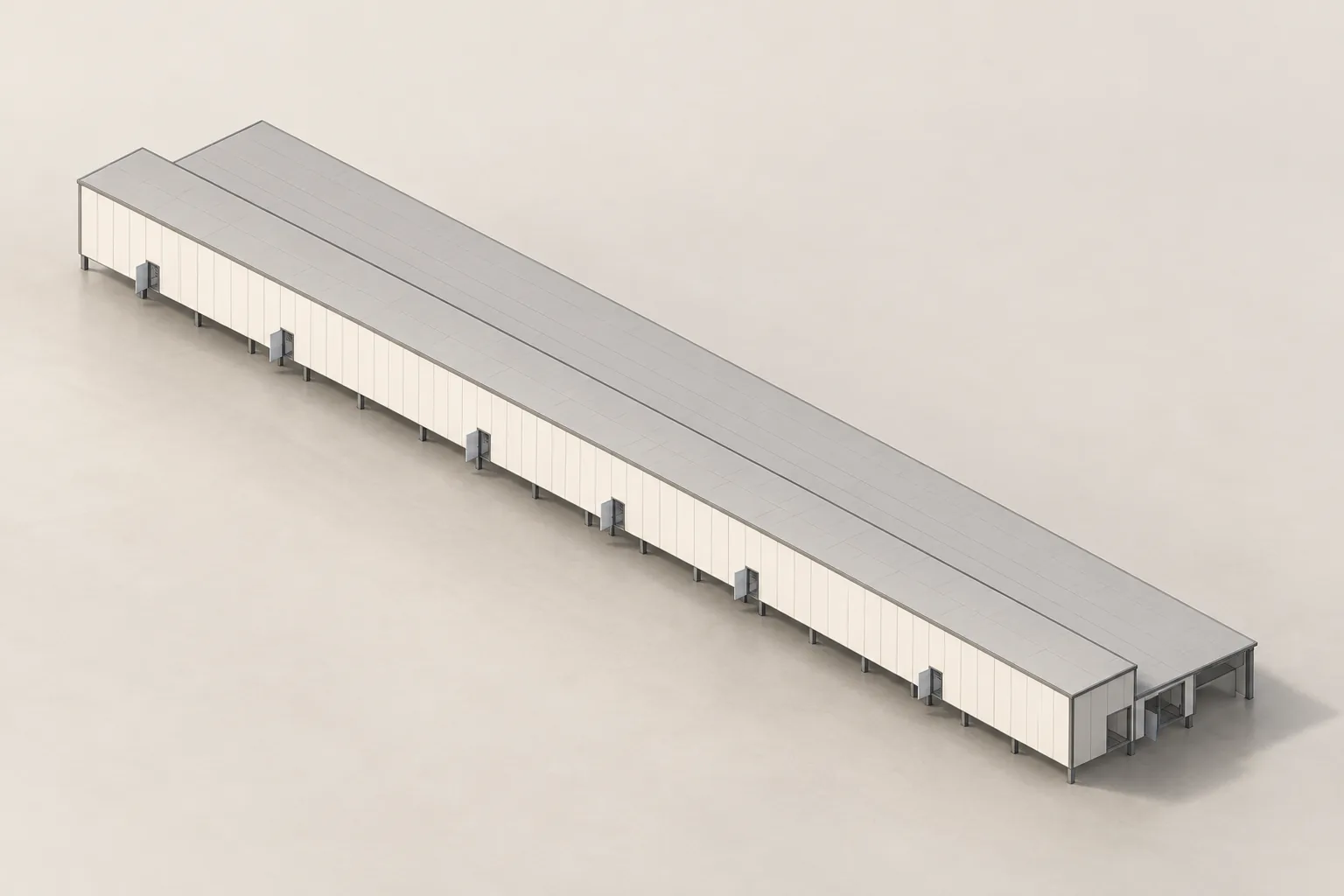
The first independent in-process read returned a null search-set reference and a held mapping of zero. Those two defects were corrected and written down as resolved. The pass that followed still could not read one identifier class as a stable ordinary property of the model.
Unexposed Fields Stay Empty, Not Substituted
An independent Manage 2027 plugin opened the federated coordination file without calling the generating plugin and without saving either coordination file. It read four search sets with their leaf members, and three clash tests with their selections, type, tolerance, state, last-run time and result count, all three Complete. Thirteen results exported a composite identifier for each side and a collision centre, with zero empty composite identifiers and zero empty centres [MODELED].
Unexposed fields are left empty. They are never filled with a substitute. Remove that rule and the same three zeros could be produced by a generous exporter. The composite prefers source file, instance identifier, display name, element identifier and visible business identifier, in that order. The zero-empty count is over those composites, not over every constituent. Source file, element identifier and business identifier are empty on many of the thirteen rows. Several electrical composites are a null instance identifier plus a family-type display name. Byte digests of both coordination files were identical before and after the read.
Leaf Count Differs by Hierarchy; Structure Is the Earlier File
The electrical search set reports 408 selected items and 82 leaves [MODELED]. Structure reports 264 and 151 [MODELED]. Liquid-cooling mechanical reports 170 and 164 [MODELED]. Maintenance envelopes, pull-out paths and no-occupancy zones report 98 and 98 [MODELED]. The difference is hierarchy inside the selection, not a missing object. Subtracting one from the other and calling the remainder lost is the error a later geometry close already forbids.
The structural search set is named as the earlier revision. The federated note claims the later structural proxy. The independent export is reading the file that was actually selected. A later baseline records that the clash script had pinned the earlier structural file while naming the output as the later revision. That is a provenance fact the semantic pass can see. It is not a clash result.
The 147 Match Is a Manifest Name Match, Not a Model Read
One geometry class's application identifier is not exposed as a stable ordinary readable property. The plugin therefore takes the held closed set in a frozen mechanical manifest as the authoritative mapping and matches it against leaf-object display names. The manifest expects 147 items; 147 unique instances matched inside the file [MODELED]. The agreement is real. It is an agreement between a frozen manifest and a name match, not between two independent readings of the model. The author recorded two things that were deliberately not done: the held objects were not rewritten into native search sets, and the model was not modified.
A read-back tests the model it is pointed at. It cannot test where those values came from. That characterisation is the author's; the source states the limitation and leaves it there.
Three Hard Tests at 0 m; Zero Is Not Clearance
Results are ten for electrical against structure, three for liquid-cooling mechanical against structure, and zero for maintenance envelopes, pull-out paths and no-occupancy zones against structure, each a Hard clash at 0 m [MODELED]. The ninety-eight-item selection is a closed set of forty-eight maintenance envelopes, forty-two pull paths and eight no-occupancy zones taken from the same frozen manifest. An earlier trial with an empty selection was archived as a recorded failure and explicitly rejected.
The federated record then states what the zero means: the current proxy envelopes and the current structural proxies do not hard-intersect. No clearance tolerance was set. A clearance that exists but is insufficient would not appear. Reading the zero as an overall no-clash result is prohibited in the same paragraph. The ten and three results are recorded open, to enter an issue register, be located and be cleared in later design. The run grades itself a partial concept pass. Geometry underneath is assumed and to-be-confirmed proxy dimensions at an internal project origin.
Elsewhere on this project one validator prints ten gate lines on every run, writing its unclosed items into its own output [TARGET]. A pass built that way survives being quoted out of context. That comparison is the author's, not a finding of the read-back.
Limits and open items
Confirmed: a validator PASS is internal closure of its dataset at the run, not a built system. [FACT]
Modelled and unfrozen: four search sets, three tests and thirteen results; zero empty composites and zero empty centres; 147 expected against 147 matched; 408 selected against 82 leaves on electrical, 264 against 151 on structure, 170 against 164 on liquid-cooling mechanical, and 98 against 98 on maintenance; ten, three and zero Hard results at 0 m; forty-eight envelopes, forty-two pull paths and eight no-occupancy zones. [MODELED]
The ten gate lines are a property of a different script [TARGET].
Open: Engineer of Record, supplier, commissioning authority, jurisdiction, survey coordinates, supplier dimensions, equipment reactions, pipe routes, the maintenance clearance standard, and construction release. Identity still depends on the frozen manifest. The ten and three results remain open. Nothing here has been sealed. Nothing is a construction clearance. [HOLD]
Do Quotes Keep Empty Fields and the Earlier Structural Set?
The useful test of the next quotation is whether it still carries the empty constituent fields and the earlier-revision structural set. If the summary leads with PASS and drops both, the run has been reported as a coordination clearance it did not earn.
© 2026 K&K Data Service Inc. All rights reserved. Reproduction or republication is permitted only with clear attribution to K&K Data Service Inc. and a working hyperlink to the canonical URL of this article. Excerpts must preserve the technical context, maturity labels, assumptions, and limitations. No excerpt may imply project approval, field validation, certification, or endorsement that the original article does not state.
Source: K&K Data Service Inc., “BIM Semantic Readback Can Pass While the Evidence Chain Stays Partial,” https://www.kkdatasvc.com/lab/bim-and-navisworks/semantic-readback-pass-evidence-chain-partial/.
Discuss This Constraint. If your project record shows a different result, or the same failure domain under another name, we want to see it. Email inquiry@kkdatasvc.com or use the contact page.