
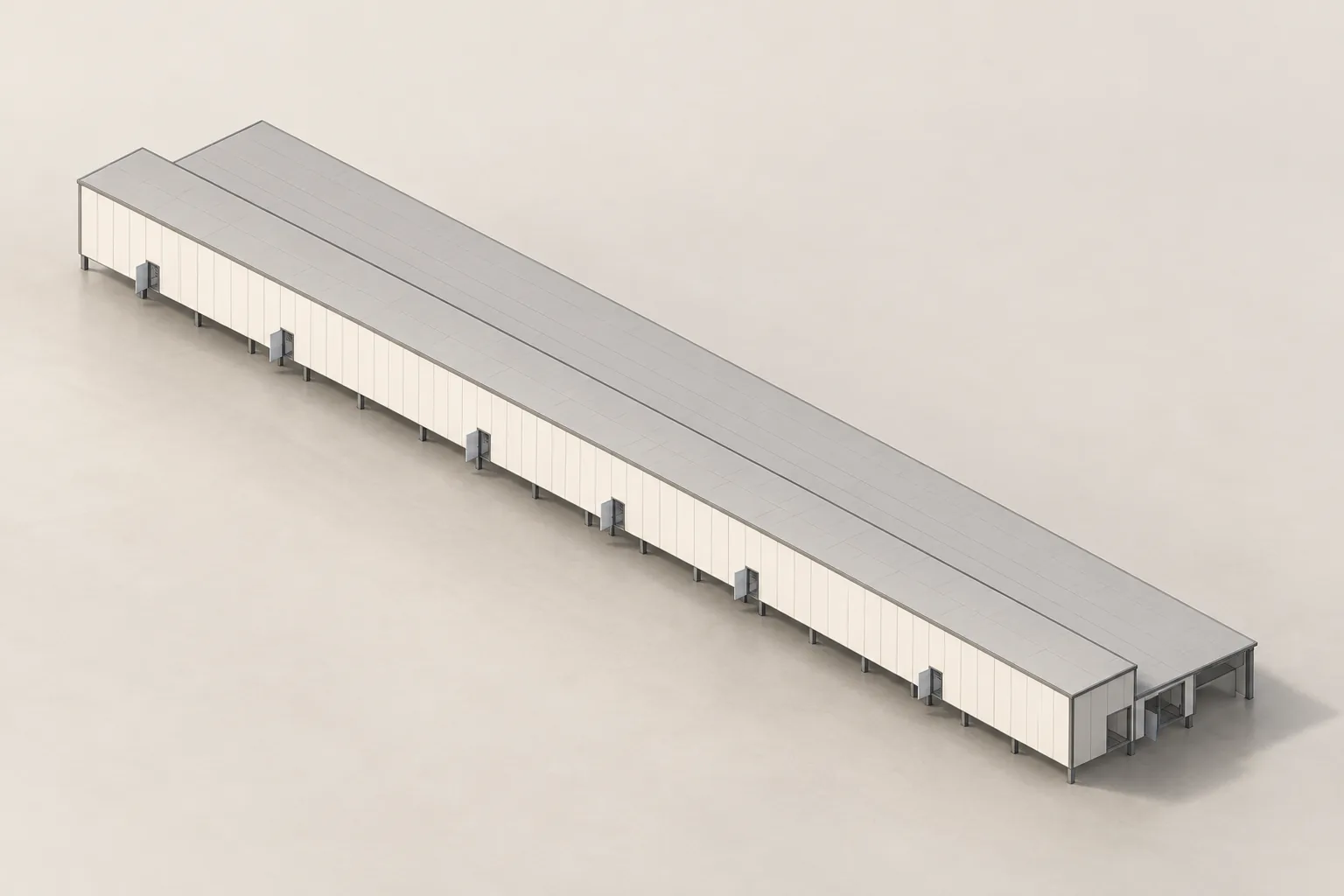
If you have to print one stamp on the federated file, which of the three columns are you going to drop? The object register refuses one specific data error: writing a commercial gate in model-state words triggers an assertion. Its 573 rows therefore retain three independent columns for evidence quality, route membership and procurement state [MODELED]. The published design index grades documents, not rows. The current execution memory grades the whole effort as internal concept. None of those three is a substitute for the others.
A Row Can Be Active, Assumed, and Not Released at Once
Recomputing the register gives the evidence column as 294 rows graded as an assumption, 74 awaiting the engineer of record, 44 awaiting an owner decision, 38 parametrically derived, 28 awaiting the authority and 25 awaiting a battery chemistry decision [MODELED]. The model-state column gives 287 held, 249 active, 37 template and none retired [MODELED]. The commercial gate gives 378 not applicable, 195 not released and zero released [MODELED]. That last zero currently bars any claim that an active row is bought, ordered or available for construction, regardless of how developed its geometry appears in the federated model.
Retired can be produced only by a change order that has already been authorised, so the zero in that cell is a procedural result and not a count of demolished equipment. Read one at a time those three distributions are unremarkable. Read together they show that a row can be active in the current route, graded as an assumption and commercially untouched all at once, and that the combination is the normal case here. Two further ladders run alongside them for geometric and information development, reading 428 and 145 rows across two geometric steps and 573 rows on a single information step [MODELED]. Neither carries a row above its second step anywhere in the file. That ceiling is held by an enumeration assertion, not by editorial habit.
One Label Cannot Stand for Evidence, Route, and Purchase
Held means a conditional branch that must be preserved. Template means a class placeholder that was never placed. Not released is a statement about money. The register assertion prevents a commercial-state term from being written in model-state words, so route membership cannot satisfy the purchase gate, and the validator checks that separation on every run. The three parallel cooling-distribution branches are the clearest case, preserved as three complete instance sets: a first branch of eleven units, carried as the research baseline; a second branch of twelve units; a third branch of fifteen units [MODELED]. All three are held. All three carry an empty procurement quantity. None has been adopted. The upstream branch rule holds in the data layer and not in a covering sentence.
The published design index adds a fourth ladder, six package levels running from no controlled file to issued-for-construction with seals. Its third step is the first permitting a long-lead budget enquiry. Its fifth is the first permitting a formal enquiry. On that ladder the object-model package is currently at the first step: no controlled model file. A 573-row register is not that file.
The current execution memory freezes the software method and not the topology. Ordinary lines after a "connection" do not count as a built system. Object counts, hashes, author comments, proxy ports or a machine PASS do not prove electrical topology, construction drawings or engineering correctness. That ban is the same three-label rule written as a prohibition instead of as a table.
Eight Non-Assertions Travel With the Validator Output
A companion table in the same package records eight explicit non-assertions: built, purchased, certified, sealed by the engineer of record, permitted, commissioned, frozen on any of four open branches, or successfully imported into the modelling platform. Each is stored as its own bounded row rather than inferred from any maturity distribution. The table travels with the validator output under its own identifier, so a pass cannot detach the result from those eight recorded bounds. The validator's own pass result is bounded in the same place to mean internal closure at the moment it ran, and it prints ten open-gate lines on every run so the limitation travels with the output [TARGET]. Four of the eight rows name branches that are open rather than positions that are unproven, among them the cooling distribution branch above and the battery chemistry, and those four are what keep 287 rows held.
Assumption is 51.3 per cent of the evidence column and two rows in the whole file are graded as fact [MODELED]. A single label averaged across 573 rows would have to be the lowest one present, hiding the 38 derived rows a reviewer can recompute. If supplier documents or engineer-of-record calculations arrive and lift a block of fields off the assumption grade, the three columns spread further apart instead of converging. That averaged label becomes more misleading than it is today.
Limits and open items
Confirmed: a commercial gate may not be written in model-state words; no row has released a procurement quantity; a validator PASS is internal closure at the run, not a built, purchased, sealed or permitted system; object counts, hashes, author comments, proxy ports and a machine PASS do not prove topology or construction drawings. [FACT]
Modelled and unfrozen: 573 rows; 294 assumption, 74 engineer-of-record, 44 owner, 38 derived, 28 authority and 25 chemistry; 287 held, 249 active, 37 template; 378 not applicable and 195 not released; 428 and 145 geometric-step rows; 11, 12 and 15 cooling-distribution units, all held; 51.3 per cent assumption and 2 fact-graded rows. [MODELED]
The ten open-gate lines are a property of the validator script [TARGET].
Open: owner adjudication of the three cooling branches; battery chemistry; engineer-of-record and authority inputs that would lift fields off assumption; a modelling-platform import that the package has not started. The object-model package remains at the first step of the document ladder. Nothing here has been sealed. Nothing is released. [HOLD]
Print all three, or print none
The useful test of the next native output is whether it still carries evidence grade, model state and procurement gate as three fields. If it carries one stamp, ask which of the other two the stamp was allowed to hide.
© 2026 K&K Data Service Inc. All rights reserved. Reproduction or republication is permitted only with clear attribution to K&K Data Service Inc. and a working hyperlink to the canonical URL of this article. Excerpts must preserve the technical context, maturity labels, assumptions, and limitations. No excerpt may imply project approval, field validation, certification, or endorsement that the original article does not state.
Source: K&K Data Service Inc., “Every BIM Output Needs Evidence, Route, and Procurement Labels,” https://www.kkdatasvc.com/lab/bim-and-navisworks/three-labels-on-every-bim-output-not-one/.
Discuss This Constraint. If your project record shows a different result, or the same failure domain under another name, we want to see it. Email inquiry@kkdatasvc.com or use the contact page.