
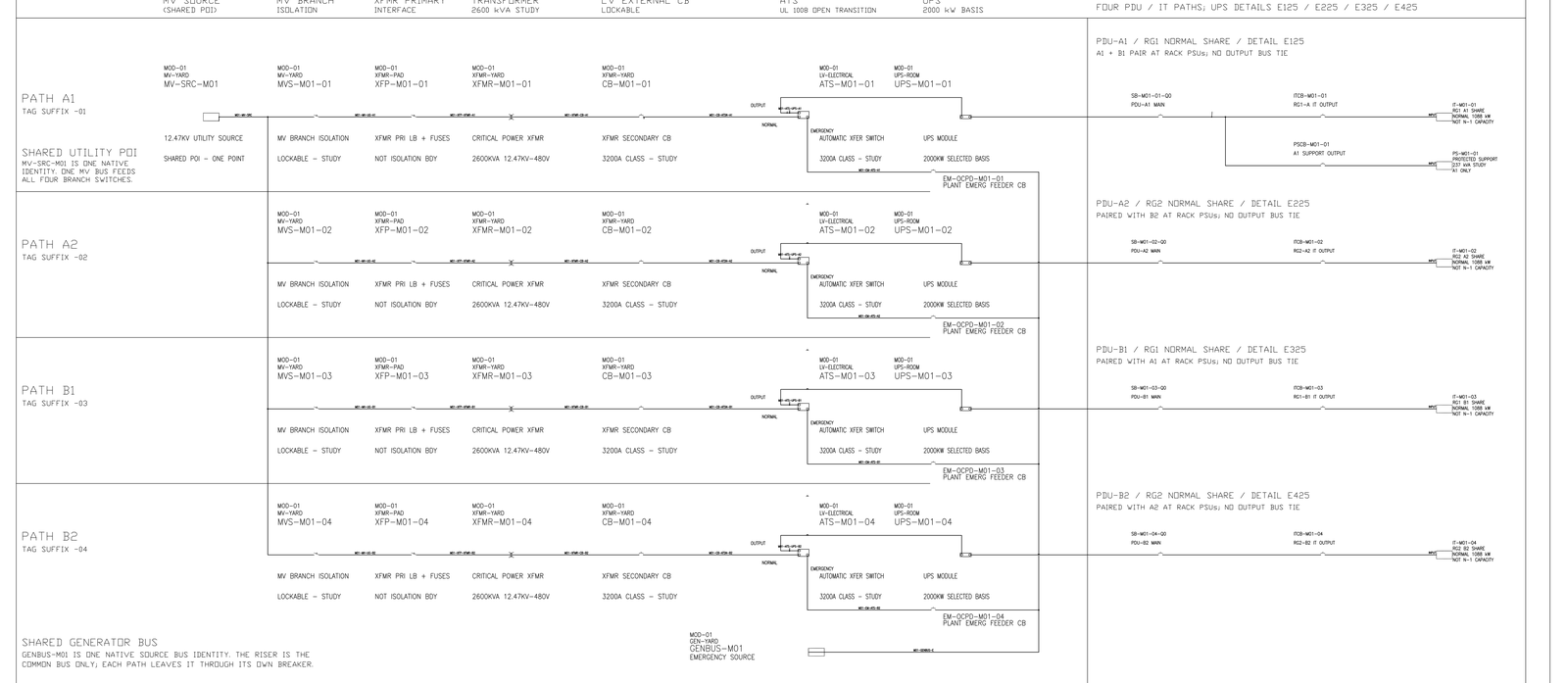
A decision-log freeze still on file says 3.3 MWh [MODELED] split into two independent paths supports about 9.9 MW [MODELED] per path for ten minutes. The Gate 1 architecture record lists a close cousin among the simplifications it will not accept: that 3.3 MWh of battery supports 12 MW [TARGET] for ten minutes on each of two paths. The quantity derivation that closed the conflict is narrower. On 12,711 kW [MODELED] of protected load, 3,300 kWh [MODELED] is 5.20 minutes [MODELED] on strict 2N, 6.93 minutes [MODELED] on 3-to-make-2, and 9.10 minutes [MODELED] on catcher. None of those is ten minutes on both paths. The claimed duration on the 2N pair requires 6.344 MWh [MODELED], so the installed figure is 52 % [MODELED] of it.
Strict 2N Shares One Battery Store Across Both Paths
The prohibited statement contains two independent multiplications. It applies the full energy to a full 12 MW load on one path, and then reuses the same energy on the second path as though 2N meant two batteries. Under strict 2N each path is sized to carry 100 % of the agreed load, which is exactly why the energy cannot be counted twice. The pair shares one store, and the store discharges once.
The Gate 1 closure review accepts the coefficient chain that produces the five-minute floors of 3.172 MWh [MODELED], 2.379 MWh [MODELED] and 1.813 MWh [MODELED] for the three candidate topologies. It accepts nothing beneath it. Chemistry, depth of discharge and the start chain are all undefined. The shared engineering register lists the five-minute battery among the items that may not be frozen. So 3.172 MWh is a floor derived from a reviewable formula, not a selected battery.
3.3 MWh Is 5.20, 6.93, or 9.10 Minutes by Topology
The quantity derivation does not scale the floor in a side calculation. It closes the decision-log freeze in a table. 3,300 kWh against the 3,172 kWh five-minute floor for the 2N pair is 3,300 ÷ 3,172 × 5 = 5.20 minutes. The same energy is 6.93 minutes on the 3-to-make-2 floor and 9.10 minutes on the catcher floor. Ten minutes on the 2N chain needs 2 × 3,172 = 6,344 kWh. Both statements are about the same pair of paths. The difference between them is a factor of 1.92 [MODELED] on installed energy, or a shortfall of 3,044 kWh [MODELED] if the ten-minute figure is the one the design is meant to meet.
Note what is not being claimed. Neither figure says the plant rides through for that long. The shared register records separately that battery minutes cannot substitute for liquid-cooling thermal inertia, and that the thermal transient and the combined integrated systems test are the release conditions. Five point two minutes of electrical autonomy on a direct-liquid-cooled hall is an electrical statement with a thermal question attached.
A later space-model sensitivity on the 3-to-make-2 floor produces a look-alike. Depth of discharge 0.70 [SENSITIVITY] on 2,379 kWh gives 3,399 kWh [SENSITIVITY] of installed energy. That number is not the 3.3 MWh freeze.
Battery-Room Area Scales One-for-One With Energy
The space model basis declines to publish a battery room area at all, and the reason is the useful part. It records that the first-order driver of area is not the nameplate energy but the product of depth of discharge and energy density, both currently unknown, and that depth of discharge alone moves installed energy across 2,379–4,759 kWh [SENSITIVITY], a factor of two. Stacking the five-to-ten-minute change on top of that gives a defensible envelope of 2,379–9,518 kWh [SENSITIVITY] — a factor of four — at which point the basis states that the battery room area cannot physically converge until the chemistry decision and the worst-case generator start time close.
Area then follows strictly inversely from a single area energy density figure the basis asks the battery supplier to provide: halve that density and the area doubles. A doubled duration therefore does not cost a footnote. It propagates through installed energy into room area at unity exponent, and it does so on top of a depth-of-discharge span that is already 2:1. The basis sets out three battery rooms at roughly 793 kWh [MODELED] nameplate each, 991–1,586 kWh [MODELED] installed, and warns that under a lithium branch this arrangement will very probably cross the indoor single-fire-area energy threshold, forcing either more compartments or an outdoor battery yard.
The space-model span starts from the 3-to-make-2 floor of 2.379 MWh. The autonomy arithmetic uses the strict 2N floor of 3.172 MWh. They are consistent within their own documents. They are not interchangeable.
Limits and open items
Confirmed: the ten-minutes-on-both-paths statement is a recorded prohibited simplification; under 2N the pair shares one energy store. [FACT]
Modelled: 3.172, 2.379 and 1.813 MWh as five-minute floors for the three candidate topologies; 5.20, 6.93 and 9.10 minutes and the 6.344 MWh ten-minute requirement, closed in the quantity derivation against 12,711 kW of protected load; the 2,379–9,518 kWh envelope; the 991–1,586 kWh per-room installed range. [MODELED]
Held: chemistry, depth of discharge, the worst-case start chain, the area energy density figure, and the battery room area itself, which the space model basis expressly refuses to estimate and flags as its fourth space blocking item. Any request for a single battery room area before those close would present a placeholder as an estimate. [HOLD]
No figure above has been reviewed or sealed by an Engineer of Record, confirmed by a battery supplier, accepted by an authority having jurisdiction, or observed on plant.
Which Rate-Table Row Was the Energy Figure Read From
A condition already in the record would move 5.2 minutes downward rather than up. The space model basis requires usable energy per cabinet to be taken from the supplier's five-minute-rate data, because a cell that delivers a given energy at the twenty-hour rate delivers materially less at high rate. Discharge here is a 6–12 C [MODELED] short-time duty, not a peaking-storage duty. If that derating is significant, the 5.2 minutes computed above is optimistic and the installed energy needed to hold five minutes rises again.
So the first question is not how many minutes to specify. It is which rate the supplier's energy figure was measured at — and whether the number now sitting in the study was read off the wrong row of that table.
© 2026 K&K Data Service Inc. All rights reserved. Reproduction or republication is permitted only with clear attribution to K&K Data Service Inc. and a working hyperlink to the canonical URL of this article. Excerpts must preserve the technical context, maturity labels, assumptions, and limitations. No excerpt may imply project approval, field validation, certification, or endorsement that the original article does not state.
Source: K&K Data Service Inc., “3.3 MWh Battery Is 5.2 Minutes on 2N, Not 10 Minutes on Both Paths,” https://www.kkdatasvc.com/lab/ups-battery-and-generation/3-3-mwh-is-5-2-minutes-on-2n-not-10-minutes-on-both-paths/.
Request the Public Calculation Note. If your project record shows a different result, or the same failure domain under another name, we want to see it. Email inquiry@kkdatasvc.com or use the contact page.