
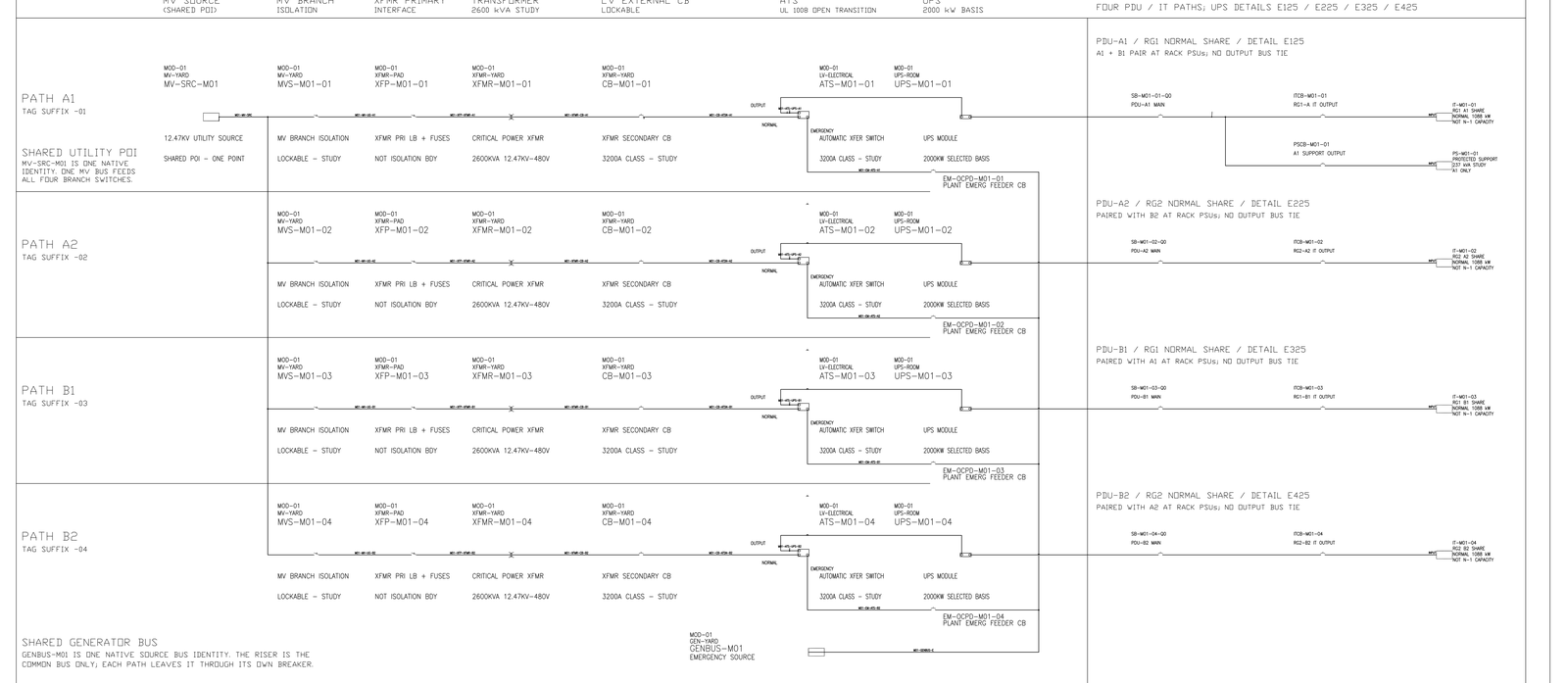
Take one complete path out for maintenance, then lose a single 2 MW [MODELED] module on the path that is left. Under the current study basis the strict 2N route carries fourteen of those modules, seven per path. The survivors give 12 MW [MODELED] against a 12.711 MW [MODELED] protected load — 0.711 MW [MODELED] short. That shortfall equals the study allowances for necessary cooling and distribution load. The closure record rejects treating those categories as sheddable by default. Their component values remain unfrozen.
Single-Fault Is Not the Maintenance-Plus-Fault Case
With all fourteen modules installed and one lost, the remaining thirteen supply 26 MW [MODELED]. That is more than twice the protected load. On that case alone the route looks generous. That is why the concurrency case has to be written down separately.
Concurrency changes the divisor rather than the numerator. A strict 2N path is a complete path, so taking one out for work leaves the other path alone with the whole protected load — seven modules, 14 MW [MODELED], against 12.711 MW, a margin of 1.289 MW [MODELED]. One module is worth 2 MW. Losing it takes the surviving path to six modules and 12.000 MW [MODELED], and 1.289 MW of margin becomes a 0.711 MW deficit in a single step. The scheme has no intermediate state because module granularity is coarse relative to the margin.
The fourteen-module count is itself a coincidence of two different rules. Gate 1 Route A's fourteen is 2(N+1) on 12 MW [TARGET] of billable IT: six modules per path plus one. The quantity derivation's fourteen is ceil(12.711 / 2) = seven per path, with no module-level N+1. The two counts match. The overlay they fail is the same.
One 2 MW Failure Exceeds the Healthy-Path Margin
The 2(N+1) branch of sixteen modules does not close the hole. The quantity derivation asserts that after the opposite path is lost and one module fails on the remaining path, six 2 MW modules still give 12.000 MW against 12.711 MW. It records the same 711 kW [MODELED] shed. Even sixteen does not cover that double event. Completely covering it would need eight modules per path and a 90 % [MODELED] per-module cap — sixteen again, now by a load-limit strategy rather than by adding units.
A later heat-rejection column, recorded as a change candidate that does not modify the electrical baseline, widens the same hole rather than closing it. Against that 13,085 kW [MODELED] candidate the overlay shortfall becomes 1,085 kW [MODELED]. The existence of the gap does not depend on adopting the candidate. Any positive auxiliary load at six modules produces a deficit.
The 0.711 MW Shortfall Is Cooling and Distribution Load
Look at what the 0.711 MW is made of and the case stops being abstract. The protected load is 12.000 MW of IT, about 0.585 MW [MODELED] of necessary coolant-distribution and pump load, and about 0.126 MW [MODELED] of end-of-line loss. Six modules cover the IT term exactly and nothing else. The deficit is not a slice of the IT load that could be shed by de-rating a few racks. It is the cooling and distribution load. The closure record specifically rejects shedding necessary liquid-cooling and control load by default. Shedding the cooling while holding the IT is the one allocation the physics will not honour for long.
Maintenance policy becomes a design input rather than an operations document. Whether a whole path may be withdrawn while the site runs at full protected load is the question that decides whether the 0.711 MW case ever occurs. Load classification becomes explicit: the cooling and control load inside the protected total needs a written priority relative to IT load, because the deficit lands exactly on it. The commissioning scope has to include this sequence. A case that only appears when maintenance and a fault coincide is a case that gets discovered in service unless it is deliberately injected.
Limits and open items
Confirmed: the arithmetic closes as shown, and the strict 2N route leaves a 0.711 MW gap in the maintenance-plus-fault case. Default shedding of necessary liquid-cooling and control load to close that gap is rejected on the current record. [FACT]
Modelled, not frozen: the sixteen-transformer and fourteen-module study basis, the 3.172 MWh [MODELED] five-minute battery floor for this route, the 26 MW single-fault remainder, the 1.289 MW healthy-path margin, and the auxiliary components behind 12.711 MW. All sit under a conditional freeze that forbids purchase orders. The battery floor may not be read as demonstrating continuity of any IT workload. The 13,085 kW change-candidate column and the 1,085 kW widening inherit the same unverified mechanical schedule. [MODELED]
Open: whether the contract permits a whole path to be withdrawn at full load; the priority order between cooling load and IT load under a protected-side deficit; and the worst-case start chain, depth of discharge and thermal inertia inputs that the battery floor still depends on. [HOLD]
No Engineer of Record has reviewed or sealed these quantities. Nothing here releases equipment for purchase.
Which 711 kW comes off
The uncomfortable feature of this case is its shape. A 2N scheme is usually defended by saying each path is complete, and each path here is complete — for IT. What it is not complete for is the load that keeps IT alive, and that distinction only becomes visible when the two paths are not both available. Before the maintenance concept is written, the question for the critical power specialist is narrow: at 12 MW available and 12.711 MW protected, which 0.711 MW comes off, in what order, and who signs that order in advance?
© 2026 K&K Data Service Inc. All rights reserved. Reproduction or republication is permitted only with clear attribution to K&K Data Service Inc. and a working hyperlink to the canonical URL of this article. Excerpts must preserve the technical context, maturity labels, assumptions, and limitations. No excerpt may imply project approval, field validation, certification, or endorsement that the original article does not state.
Source: K&K Data Service Inc., “Strict 2N UPS Misses 0.711 MW Protected Load in Maintenance-Plus-Fault,” https://www.kkdatasvc.com/lab/ups-battery-and-generation/strict-2n-still-misses-0-711-mw-in-maintenance-plus-fault/.
Request the Public Calculation Note. If your project record shows a different result, or the same failure domain under another name, we want to see it. Email inquiry@kkdatasvc.com or use the contact page.