
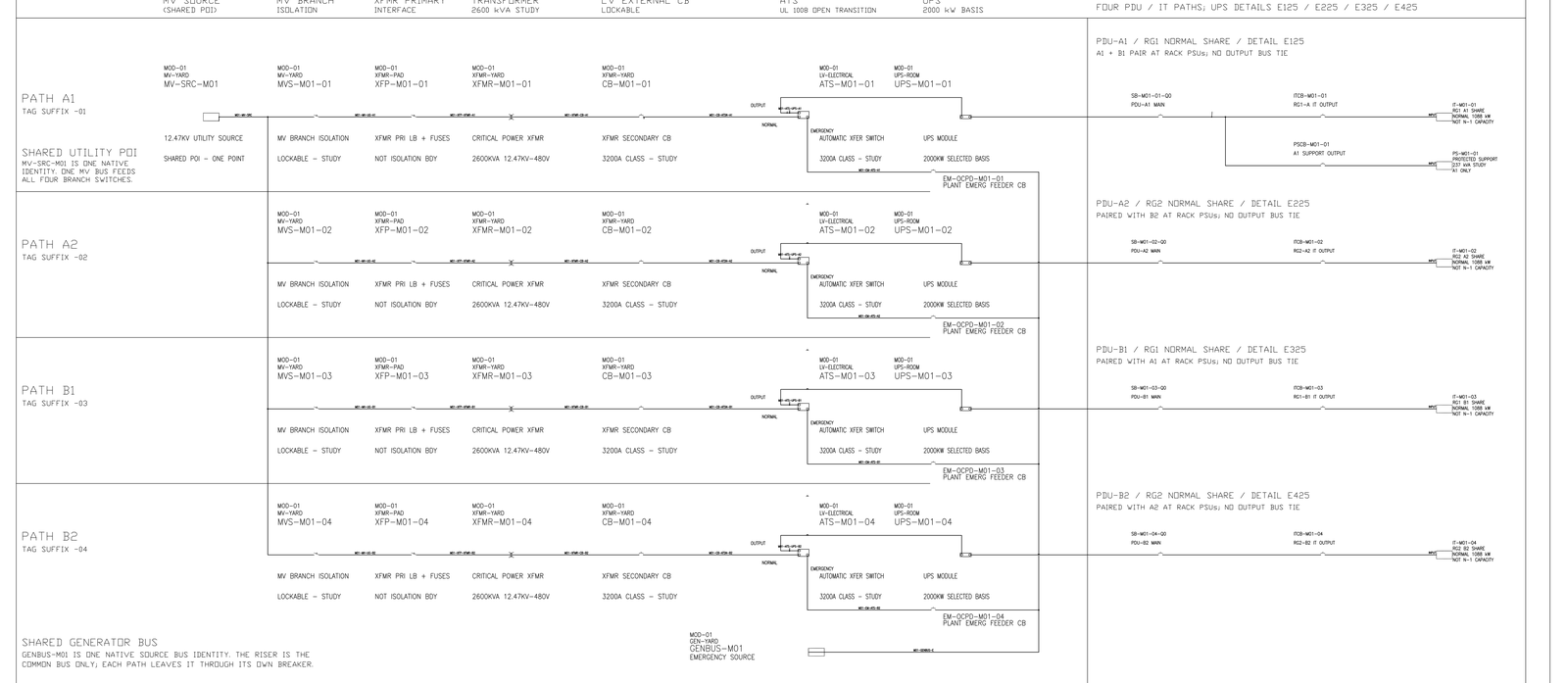
The Gate 1 architecture record still listed nine 2 MW [MODELED] uninterruptible-supply modules as 3-to-make-2 redundancy. Route B sized that count on 12 MW [TARGET] of billable IT: three systems at about 4 MW each in normal operation, each rising to about 6 MW when one system withdraws, hence three modules per system. Every step of that is correct against 12 MW. None of it is correct against the 12.711 MW [MODELED] protected-load study basis the later quantity derivation closed on. After one of three systems exits, each survivor must carry 6,355.5 kW [MODELED]. Three 2 MW modules make 6.000 MW [MODELED]. The surviving system is 355.5 kW [MODELED] short.
Nine Was Sized on 12 MW IT, Not Protected Load
The nine-unit figure is not a vendor option that later numbers overtook. It is a denominator error that survived from a preliminary comparison into a quantity that had to be killed by arithmetic.
At architecture-decision stage the distributed-redundant route omitted the auxiliary terms. The protected load is the sum of three items: 12.000 MW [TARGET] of IT, roughly 0.585 MW [MODELED] of necessary coolant-distribution and pump load, and roughly 0.126 MW [MODELED] of end-of-line loss. Those close to 12.711 MW, and the Gate 1 electrical closure accepts the summation. The 0.585 MW and 0.126 MW components remain unverified. They may not be described as procurement facts.
Run the 3-to-make-2 steps on that total rather than on the sales number:
one system out    -> 12.711 / 2        = 6.3555 MW per surviving system
installed         -> 3 x 2.0 MW        = 6.000  MW per system
shortfall         -> 6.356 - 6.000     = 0.356  MW per system  (5.6%)
The closure row records the same result as 6.356 MW [MODELED] required against 6 MW installed. The 0.356 MW [MODELED] gap is 5.6 % [MODELED] of that required capacity, not of the 6.000 MW installed. The quantity-derivation file that produced the row is more specific still: 355.5 kW is 92 % [MODELED] of the 385 kW [MODELED] coolant-distribution pumping allowance. On a liquid-cooled plant that shortfall is not a rounding remainder. It is almost the entire pumping plant that keeps coolant moving while the IT still has power.
Three 2 MW Modules Cannot Cover 6,355.5 kW
The module grain is what makes nine fail rather than a vendor rating. 6,355.5 kW sits between three 2 MW modules and four. Three give 6,000 kW. Four give 8,000 kW [MODELED]. There is no intermediate nameplate. The quantity derivation therefore takes four modules per system and twelve in total as the current study quantity for this route. It is not released for purchase.
That twelve-against-fourteen comparison later prices the real save at 14 % [MODELED] of installed uninterruptible capacity, not the 25 % [MODELED] Gate 1 had used as a talking point for Route B. The 25 % figure was computed before the auxiliary terms entered the divisor. Once they do, nine is not a cheaper 3-to-make-2. It is not 3-to-make-2 at all.
A 2.5 MW [MODELED] module at three per system would still close, and would be the only remaining path that still "saves 25 %." It conflicts with the 2 MW task-book rating. The quantity derivation treats it as a contrast only.
Even Zero Auxiliary Load Leaves No Margin
Strip both auxiliary components out entirely and the requirement falls to 12.000 / 2 = 6.000 MW [SENSITIVITY] per surviving system — exactly the installed figure, with zero margin for load growth, module derate, unbalanced transfer or measurement tolerance. The nine-unit count therefore fails on any positive auxiliary load. That is why the closure record treats the rejection as arithmetic rather than as a sizing question to be reopened when better numbers arrive.
The shared engineering register lists 9 × 2 MW among the errors that may not be revived. The closure record lists the same negative as freezable: 9 × 2 MW cannot form 3-to-make-2 at 12.711 MW, accepted and withdrawn.
Limits and open items
Confirmed: the arithmetic closes as shown, and the nine-unit arrangement does not satisfy 3-to-make-2 at 12.711 MW. [FACT]
Modelled, not frozen: the 0.585 MW auxiliary allowance, the 0.126 MW end-of-line loss, the 6,355.5 kW per-system requirement, the 355.5 kW shortfall, and the twelve-module study quantity of four 2 MW modules per system. The 385 kW pumping figure and the 96.5 % [MODELED] conversion efficiency behind the input-side check remain unverified assumptions. None is released for purchase. Sizing uninterruptible modules by dividing the billable IT figure into whole modules is a study prohibition, not a frozen rule. [MODELED]
Still open: the rack pairing matrix and load-transfer proof for three systems feeding dual-cord racks; whether 3-to-make-2 is the scheme in contract terms; and whether the contract requires each path to carry 100 percent of protected load independently, which would return the design to a strict 2N route and change every count in this note. [HOLD]
No Engineer of Record has reviewed or sealed these quantities. Nothing here authorises an order.
Write the Protected-Load Divisor First
Nine was arithmetically correct against the 12 MW billable-IT figure. That figure omitted the auxiliary terms the protected-load study basis carries. Before the next count is frozen, the electrical lead should identify the divisor and write its component terms beside it. Otherwise the same substitution remains available at the next revision.
© 2026 K&K Data Service Inc. All rights reserved. Reproduction or republication is permitted only with clear attribution to K&K Data Service Inc. and a working hyperlink to the canonical URL of this article. Excerpts must preserve the technical context, maturity labels, assumptions, and limitations. No excerpt may imply project approval, field validation, certification, or endorsement that the original article does not state.
Source: K&K Data Service Inc., “A Nine-Unit 3-to-Make-2 UPS Does Not Cover 12.711 MW Protected Load,” https://www.kkdatasvc.com/lab/ups-battery-and-generation/9-x-2-mw-cannot-be-3-to-make-2-on-12-711-mw/.
Request the Public Calculation Note. If your project record shows a different result, or the same failure domain under another name, we want to see it. Email inquiry@kkdatasvc.com or use the contact page.