
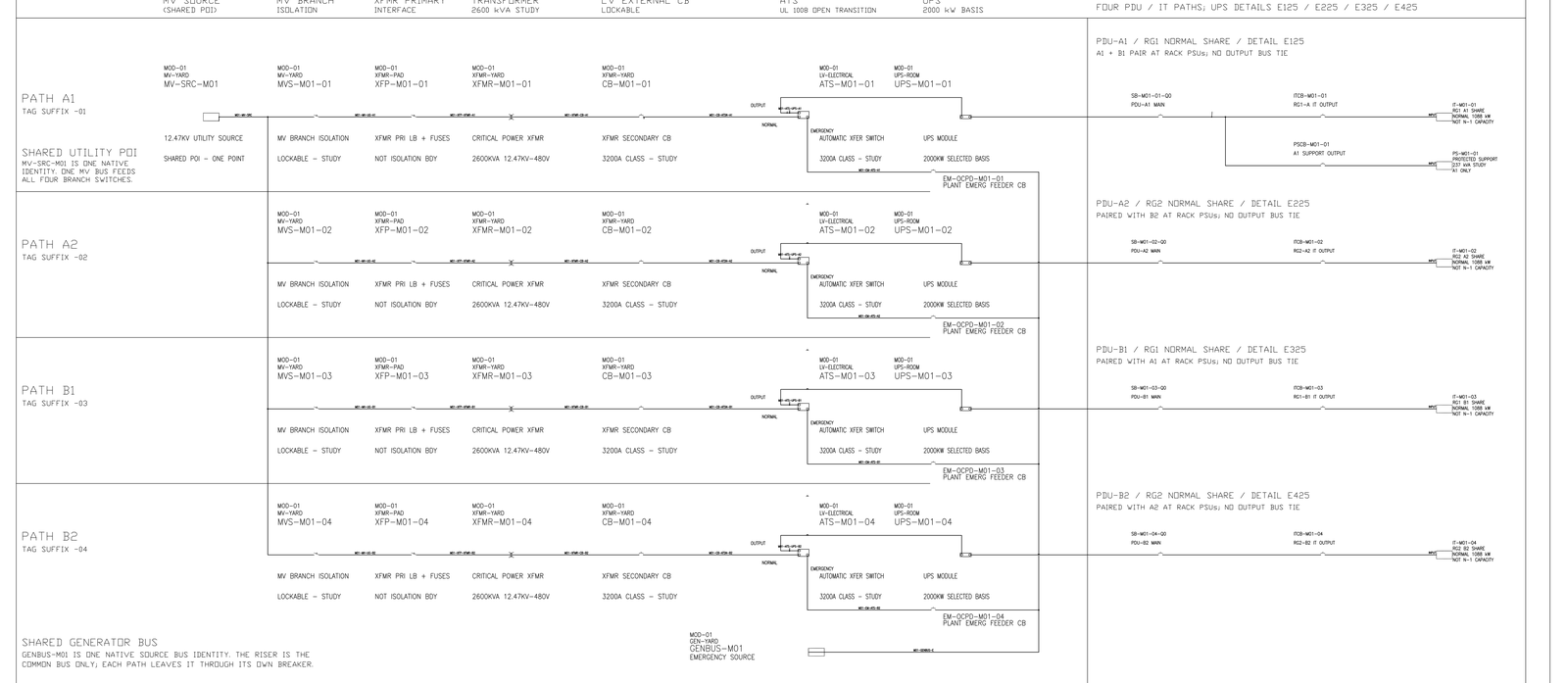
When the catcher is in maintenance, which working block is protected? When the transfer refuses, which block is caught? When two working blocks fail at once, which of them does the single spare take? The Gate 1 closure review accepts that a single 2 MW [MODELED] catcher can pick up one working block of about 1,816 kW [MODELED], and then rejects the topology for those three named events. The rejection is not a reliability estimate. It follows from there being one catcher, which is what makes the arrangement useful as a cost reference and useless as a service-level topology.
The Three Events Follow From Having One Catcher
An event that is defeated by construction cannot be engineered out inside the topology that defines it. The reviewer's wording for the three events is that they follow directly from the single-catcher definition. The disposition recorded against them is acceptance of "does not satisfy" rather than a probability, a mitigation or a condition.
That distinction matters in a decision record because the usual response to a redundancy finding is to improve the equipment. Here, a better catcher, a faster transfer or a higher-grade switch changes none of the three events. Each of them is a case in which the single catcher is either already committed, unavailable, or asked to be in two places.
Catcher maintenance is the first. While the catcher is out for service, the arrangement has no reserve at all. Every working block is running unprotected against its own failure, and the duration is scheduled rather than random. The failure matrix records the loss at about 1,816 kW of protected load, about 14.3 % [MODELED] of 12,711 kW [MODELED].
Transfer refusal is the second. The catcher only delivers redundancy through a transfer that has to operate on demand. A refusal to transfer converts a single block failure into a block outage. The topology's redundancy is conditional on an action rather than on installed capacity, unlike the 2N and 3-to-make-2 cases, where the alternative path is already energised.
Simultaneous failure of two working blocks is the third, and it is the arithmetically obvious one: one catcher covers one block. The closure review adds a fourth condition that is not yet an accepted failure and is not yet a proof either. The claim that a single medium-voltage event removes at most one block remains unproven. If it is false, the third event is not remote at all. It is the ordinary consequence of a bus fault.
A 2 MW Catcher Can Pick Up One Block as a Cost Reference
Capacity was accepted. A 2 MW catcher against a roughly 1,816 kW block is a genuine single-block capability. The arrangement was priced into this study at ten transformers, eight 2 MW uninterruptible-supply units and a five-minute battery floor of 1.813 MWh [MODELED] — against sixteen transformers and fourteen 2 MW units for strict 2N. Eight units is 57 % [MODELED] of the fourteen units strict 2N requires for the same 12,711 kW of protected load, and ten transformers against sixteen is the same story on the transformer side.
The working-block loading that produces that 1,816 kW figure is 90.8 % [MODELED] of a 2 MW module. The quantity derivation warns that a working block above 1,900 kW [MODELED] overloads the catcher on transfer. There is no second catch. Catcher busy means no second fault.
That is precisely what a cost reference is for. The closure record's Gate 1 status section freezes the negative finding: the catcher does not satisfy under catcher occupancy, transfer refusal or simultaneous dual-block fault. The shared engineering register records the topology as a cost comparison only, explicitly not the service-level topology. Keeping it in the study as a denominator is legitimate. The prohibited move is quoting its equipment count without the three events attached.
Keep the count next to the events
A cost reference survives in a document set far longer than the reasoning attached to it, because a number with three fewer transformers travels easily and a three-event rejection does not. The practical protection is not a footnote. It is that the equipment count and the rejection live in the same table row, so that quoting one carries the other.
Two of the three events would change character under a different arrangement — more than one catcher, or a proven bus partition that bounds an event to one block. Both change the topology into something that is no longer the catcher case as defined, and would need their own counts. An eight-working-block plus catcher branch of nine units is recorded as a contrast only. It is not this case.
Limits and open items
Confirmed: the three events are not satisfied, and the finding follows from the single-catcher definition rather than from equipment quality; the topology is retained as a cost reference and is rejected as the service-level topology. [FACT]
Modelled and conditionally frozen: ten transformers, eight 2 MW units, the 1.813 MWh five-minute battery floor, the roughly 1,816 kW per-block figure and the 90.8 % working-block loading. The closure review permits these as study quantities and prohibits purchase orders against them. The battery floor additionally depends on a worst-case start chain, depth of discharge and chemistry that are all undefined. [MODELED]
Held: whether a single medium-voltage event can remove more than one working block, which the review records as unproven and which bears directly on the third event. [HOLD]
Nothing above reflects Engineer of Record review, equipment supplier confirmation, commissioning acceptance or observed plant behaviour.
Price the Catcher Against Protected Load, Not 12 MW IT
The question a decision record can usefully leave open is therefore about the comparison, not the topology: when the catcher figures are used as the cost denominator, is the alternative being priced against the same protected load of 12,711 kW, or against the 12,000 kW [TARGET] that only the contract uses?
© 2026 K&K Data Service Inc. All rights reserved. Reproduction or republication is permitted only with clear attribution to K&K Data Service Inc. and a working hyperlink to the canonical URL of this article. Excerpts must preserve the technical context, maturity labels, assumptions, and limitations. No excerpt may imply project approval, field validation, certification, or endorsement that the original article does not state.
Source: K&K Data Service Inc., “Catcher UPS Fails Maintenance, Transfer Refusal, and Dual-Block Fault,” https://www.kkdatasvc.com/lab/ups-battery-and-generation/catcher-fails-three-named-events-by-construction/.
Discuss This Constraint. If your project record shows a different result, or the same failure domain under another name, we want to see it. Email inquiry@kkdatasvc.com or use the contact page.