
Does the transfer and load-shed sequence have one branch or two? If it has one, which of the two shortfalls was it written against? Two incoming feeders serve this site from one substation, rated 8 MW [TARGET] and 7 MW [TARGET]. Losing the larger one leaves a 7,391 kW [MODELED] shortfall against facility demand. Losing the smaller one leaves 6,391 kW [MODELED]. The two events are 1,000 kW [MODELED] apart. The gap equals the difference in feeder ratings exactly, and it survives unchanged when the facility figure is recomputed on a different itemisation. A single "single-feeder loss" case in a control narrative is one case too few.
Two feeder losses, two shortfalls
The Gate 1 closure review states the arithmetic directly: against 14,391 kW [MODELED] of facility demand, 14.391 − 7 = 7.391 MW and 14.391 − 8 = 6.391 MW. Both shortfalls must be picked up by on-site generation or removed by load shedding. The Gate 1 architecture record forbids the assumption that the surviving feeder independently carries the site.
The heat-rejection basis re-runs the same two events on its own steady facility figure of 14,125 kW [MODELED] and reports 7,125 kW [MODELED] and 6,125 kW [MODELED]. Different denominator, different absolute numbers, same 1,000 kW separation. That is the point worth carrying: the separation is not sensitive to which facility total is correct, because it is set by the feeder ratings and cancels out of the subtraction.
The 1 MW Shortfall Gap Is Set by the Feeder Ratings
An asymmetry that survives a recomputation is a structural property. It has a consequence for the generation plant that a symmetric case would hide. The larger event demands 7,391 kW of pickup. The smaller demands 6,391 kW. Sequencing, block loading and the shed list are therefore being designed against two different worst cases that differ by more than a full generator unit at the study basis of 2.25 MW [MODELED] net per unit.
The heat-rejection basis also shows what the normal-state allocation looks like once the asymmetry is accepted rather than averaged away. Allocating in the 8:7 ratio of the ratings puts 7,533 kW [MODELED] on the larger feeder and 6,592 kW [MODELED] on the smaller, giving both the same 94.17 % [MODELED] utilisation and leaving 467 kW [MODELED] and 408 kW [MODELED] of headroom respectively. Equal utilisation, unequal load — which is the opposite of the intuition that a redundant pair should be loaded equally, and the reason the shared engineering register records that mechanical and house load must be biased toward the larger feeder rather than split evenly.
Bias Makes the Two Feeder Losses Into Different Plants
Biasing the mechanical and house allocation is what makes the two failure cases genuinely different plants rather than two sizes of the same plant. The 14,391 kW total contains 1,031 kW [MODELED] of mechanical and house demand at medium voltage. If that block sits predominantly on the larger feeder, then losing the larger feeder removes both the bigger share of IT-supporting load and the bulk of the mechanical load that the remaining IT still needs, while losing the smaller feeder removes mostly IT-supporting load with the mechanical block intact.
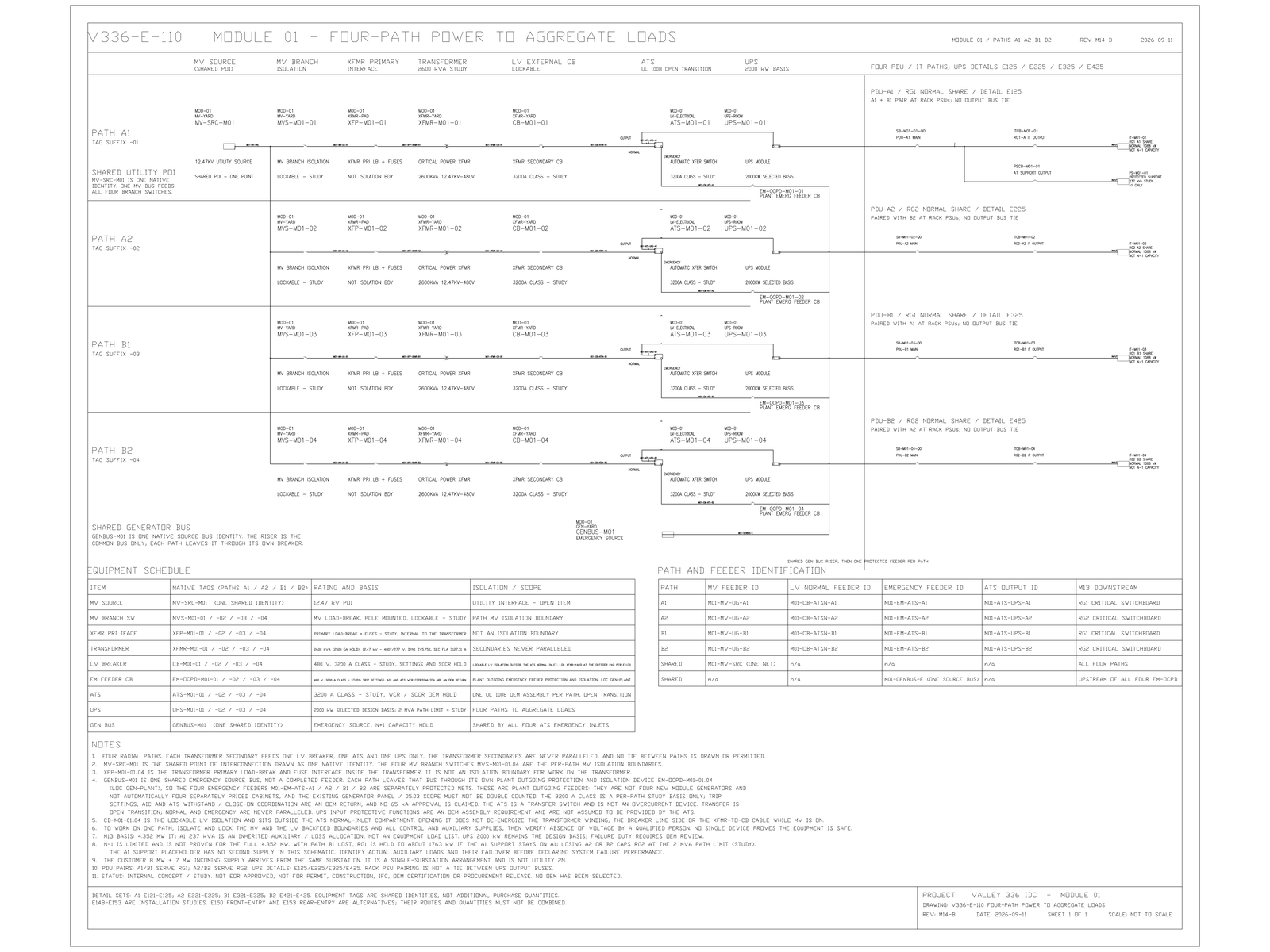
The Gate 1 architecture record already separates the two ideas that are usually collapsed here: low-voltage A/B existing does not mean every upstream stage is 2N [FACT], and two feeders from one substation are not an independent dual utility supply. A path-A loss and a path-B loss inherit that distinction. They are not mirror images at the low-voltage layer either, because the low-voltage paths carry different mechanical and house allocations by design.
Limits and open items
Confirmed: the two feeders share one substation and are not an independent dual supply or a utility 2N arrangement; neither surviving feeder can carry the site; a 50/50 normal-state split overloads the 7 MW feeder, which is treated in its own note. [FACT]
Modelled: 7,391 kW and 6,391 kW against 14,391 kW; 7,125 kW and 6,125 kW against 14,125 kW; the 8:7 allocation at 7,533 kW and 6,592 kW with 94.17 % utilisation and 467 kW and 408 kW of headroom; the 1,031 kW mechanical and house component. The closure review accepts the allocation principle but records the allocation itself as pending a load-flow study. [MODELED]
Held: which specific loads sit in the biased mechanical block, and the shed list for each of the two events. The 14,125 kW figure additionally belongs to a document whose weather chain the shared engineering register declares to have been developed against the wrong location, leaving its weather-dependent outputs as formula templates without site effect until a site-correct recomputation is done. [HOLD]
No statement here reflects Engineer of Record review, utility acceptance, commissioning acceptance or measured plant behaviour.
Does the Sequence Have One Branch or Two
A single condition would collapse the two cases into one: if the mechanical and house block were arranged so that the same loads shed, in the same order, in both events, the difference in pickup would reduce to the difference in IT-supporting load alone. The current record does not establish that. The shared register's instruction to bias mechanical load toward the larger feeder points away from it.
So the question for whoever writes the transfer and load-shed sequence is narrower than it looks. Does the sequence have one branch or two, and if it has one, which of the two shortfalls was it written against?
© 2026 K&K Data Service Inc. All rights reserved. Reproduction or republication is permitted only with clear attribution to K&K Data Service Inc. and a working hyperlink to the canonical URL of this article. Excerpts must preserve the technical context, maturity labels, assumptions, and limitations. No excerpt may imply project approval, field validation, certification, or endorsement that the original article does not state.
Source: K&K Data Service Inc., “8 MW and 7 MW Feeder Losses Leave Different Generation Shortfalls,” https://www.kkdatasvc.com/lab/electrical-architecture-and-failure-domains/losing-path-a-and-path-b-are-not-the-same-plant/.
Discuss This Constraint. If your project record shows a different result, or the same failure domain under another name, we want to see it. Email inquiry@kkdatasvc.com or use the contact page.