
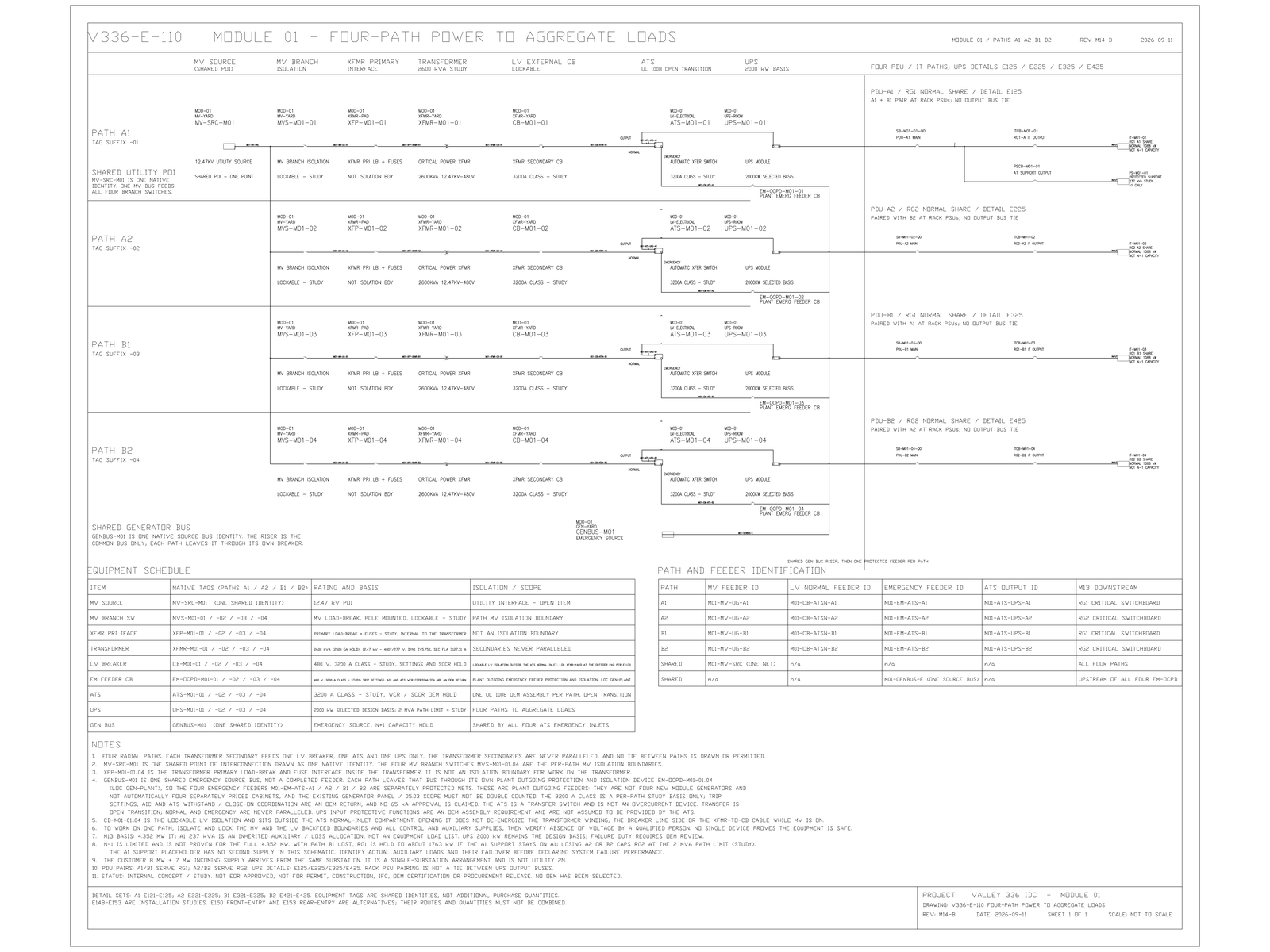
The hydraulic basis set three independent cooling zones so that the largest single cooling event reaches one third of site IT. The electrical study then inherited a block named for 4 MW. 4,000 kW [TARGET] is the one quantity in the block that nobody has to compute: it is one third of the 12,000 kW [TARGET] billable IT figure the contract sets. Every other figure attached to the same block is larger. Divided across the same three blocks, protected load is 4,237 kW [MODELED] and facility demand is 4,797 kW [MODELED] — a spread of 797 kW [MODELED], or 20 % of the block name, between the smallest and largest figure a single block can legitimately be called.
The Same Block Name Covers Three Different Cuts
The Gate 1 closure record builds protected load as 12,000 + 585 + 126 = 12,711 kW [MODELED], where the 585 kW [MODELED] is cooling-distribution auxiliary demand and the 126 kW [MODELED] is end-of-path loss. It builds facility demand as 13,317 + 1,031 + 43 = 14,391 kW [MODELED]. Those two totals are what the per-block figures come from. The closure review accepted the summations while explicitly declining to accept the components: the 385 kW [MODELED] of CDU demand, the 200 kW [MODELED] of facility pump demand, the 1 % [MODELED] end-of-path loss and the 96.5 % [MODELED] conversion efficiency are recorded as assumptions that may not be stated as procurement facts.
Three blocks is not an electrical decision. It comes from the hydraulic basis, which sets three independent cooling zones so that the largest single cooling event reaches one third of site IT. At a liquid-capture fraction of 0.95 [MODELED] that zone carries 3,928 kW [MODELED] of liquid heat, leaving roughly 72 kW [MODELED] per block on the air side, and corresponds to about 31 racks at 130 kW [MODELED].
The Protected Step Cannot Drop; the Facility Step Is Pickup
The 237 kW [MODELED] step from billable to protected is not overhead in any general sense. It is 195 kW [MODELED] of cooling-distribution auxiliary demand and 42 kW [MODELED] of end-of-path loss, each one third of its site total. Both are inside the uninterruptible supply rather than outside it — which is the whole reason they raise the protected figure rather than sitting alongside it.
The 560 kW [MODELED] step from protected to facility is a different kind of quantity. It is the block's share of the 1,031 kW of mechanical and house demand and the 43 kW of medium-voltage loss that on-site generation has to pick up but an uninterruptible supply does not carry. So the two steps are not comparable: the first is load that must not be interrupted, the second is load that must be picked up. Adding them to get a single 797 kW figure would merge two different obligations, which is exactly what the block name already does once.
The Three Cuts of a 4 MW Block Do Not Land Together
A block boundary cuts three systems at once, and the three cuts do not land together. Cut electrically, the block is a share of a protected-load total. Cut hydraulically, it is one of three cooling zones. Cut commercially, it is 4,000 kW of billable capacity. Only the commercial cut is a round number, and it is the only one of the three that no engineering document produced.
The consequence is narrow and specific: any schedule, one-line or model that labels an object "4 MW block" has to say which of the three cuts it made, because a transformer sized on 4,000 kW and a transformer sized on 4,237 kW are different transformers. The shared engineering register already requires a roughly 4 MW standard module to pass a native pilot — object read-back, load and panel-schedule read-back, human legibility and topology review — before the arrangement is replicated across the site. That pilot is the first place the three cuts have to be reconciled on one object, and it is the last place where reconciling them is cheap.
Limits and open items
Confirmed: 12,000 kW is billable IT and 15,000 kW [TARGET] is a facility input ceiling that is not an IT capacity basis; the block count of three follows from the cooling zoning decision. [FACT]
Modelled, not frozen: 4,237 kW and 4,797 kW per block, the 237 kW and 560 kW steps between them, and the 12,711 kW and 14,391 kW totals behind them, together with every component — 585, 126, 13,317, 1,031 and 43 kW. The 3,928 kW liquid heat and the roughly 72 kW air-side residue carry the same status, and the liquid-capture fraction is bounded at 0.97 [MODELED] because in-rack power supplies, optics, management boards and fans leave a residual air share the hydraulic basis puts at 3 % to 8 % [MODELED]. [MODELED]
Open: the item-by-item controlled load schedule behind 14,391 kW; whether protected load and facility demand in fact divide evenly across the three cooling zones, which no source states and which every per-block figure here assumes; and the customer's maximum acceptable simultaneous cooling-loss domain, which the hydraulic basis logs as an open decision. [HOLD]
Nothing above has been reviewed or sealed by an Engineer of Record. No quantity is released for procurement. No figure describes an installed or operating system.
Which Cut Does the Next 4 MW Block Label Name
If the maximum acceptable cooling-loss domain comes back at one sixth rather than one third, the zoning goes from three to six, the CDU count and ring are rearranged, and the block becomes a 2 MW [SENSITIVITY] block with all three of its cuts halved. The name would change. The gap between the cuts would not, because it is a ratio and not a quantity.
So the useful question is not which figure the block should be named for. It is whether the next document to use the phrase "4 MW block" will state, in the same view as the number, which of the three cuts it made.
© 2026 K&K Data Service Inc. All rights reserved. Reproduction or republication is permitted only with clear attribution to K&K Data Service Inc. and a working hyperlink to the canonical URL of this article. Excerpts must preserve the technical context, maturity labels, assumptions, and limitations. No excerpt may imply project approval, field validation, certification, or endorsement that the original article does not state.
Source: K&K Data Service Inc., “A 4 MW Zone Block Is 4,000 Billable, 4,237 Protected, 4,797 Facility,” https://www.kkdatasvc.com/lab/electrical-architecture-and-failure-domains/the-4-mw-block-is-4-000-billable-4-237-protected-and-4-797-facility/.
Request the Public Calculation Note. If your project record shows a different result, or the same failure domain under another name, we want to see it. Email inquiry@kkdatasvc.com or use the contact page.