
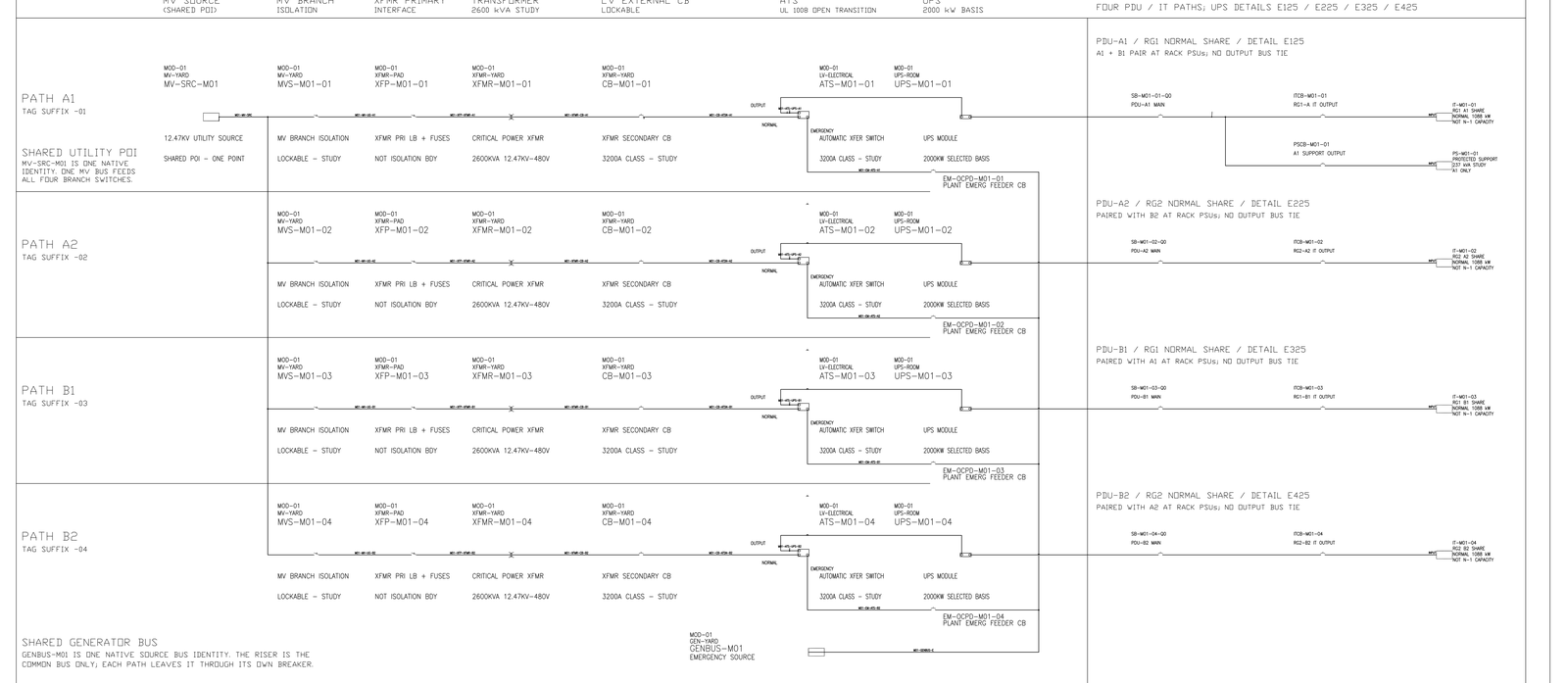
The restoration state machine in the heat-rejection basis runs S0 normal utility, S1 uninterruptible bridging, S2 generator establishment, S3 stepped loading, S4 stable generation, S5 retransfer preparation, S6 retransfer execution and S7 charge recovery. The controls basis then records that this list does not cover the case the site is most likely to see: one feeder lost while the other is still energised. Its finding on S2 is the one that decides how the sequence may be written. S2 and S3 assume the generator builds on a bus that is already dead. Where the surviving feeder is still live, the isolate-or-parallel question has to be answered and acted on before any generator breaker closes, or the machine closes onto an energised bus.
The Eight-State List Omits a Remaining Live Feeder
The controls author grades that gap as having no input at all, and adds three states rather than editing the eight that exist: S-B black start, S-I islanded, S-P paralleled. S-I and S-P are written as mutually exclusive. The choice between them is made to depend on three documents held by three different parties: the serving utility's written position on customer-side generation running in parallel with the distribution network, the Engineer of Record's determination, and the generator control manufacturer's description of operation. None of the three is in the read set. The controls basis states that it contains no sealed content of any kind.
That is why the instruction in the record is not "parallel" and not "island" but "do not default." The same document forbids freezing either branch, writing either into the final sequence of operation, entering either in the procurement package as a must-implement item, or executing an actual paralleling operation during integrated systems testing. The heat-rejection basis had already named the same fork from the cooling side: a future freeze of one of two modes still to be Engineer-of-Record verified — remaining utility and generators in a controlled share, or isolate then island. Closed-loop paralleling needs written utility conditions. Neither islanding nor paralleling is a default.
Paralleling Needs a Utility Letter; Islanding Does Not
The asymmetry between the two branches is not in their difficulty. It is in who has to sign.
Islanding adds no interconnection equipment. What it adds is a set of engineering answers the project owes itself: where the isolation point sits and what switch type it is, the isolation criterion and its time delay, the backup if isolation fails, and the conditions under which the disconnected feeder may be reconnected. Those are gradeable by the design team plus the Engineer of Record.
Paralleling adds synchronising equipment, an interconnection point, anti-islanding and reverse-power protection, changes to short-circuit duty and protection coordination, and a harmonics and power-quality study. Every one of those is downstream of a letter that does not exist. The heat-rejection basis registers the same dependency on the retransfer branch S5 to S6, which asks whether the transition is closed, and defers the answer to the utility permit and to a transient study that has not been commissioned.
Because the branches diverge, the drafting rule follows from which one can be advanced without a third party. The sequence can be written to isolate first — establish generation on a bus the site has deliberately separated — without asking anyone for permission, and that draft stays valid whichever way the permit question eventually falls. A sequence written the other way is void the day the utility says no.
This is an author's reading of the record, not a quotation from it. The controls basis explicitly declines to rank the two, and its own stated reason for keeping both branches alive is that carrying two sets of points, interlocks and test cases costs document redundancy, while dropping one costs rework and re-consent.
The Isolate-First Sequence Can Be Drafted Now
Writable: the object list, the interlock positions and the test cases for both branches; the isolation questions listed above, which are engineering work with named owners; and the observation that the existing S2 and S3 already presume an isolated bus, so a site that does not isolate is running a sequence outside its own written premise. [HOLD]
Not writable: any statement that paralleling is available, any synchronising setting, any interconnection point, and any test that energises a tie. Nothing here reflects Engineer of Record review, serving-utility consent, equipment supplier confirmation or commissioning acceptance, and no isolation or paralleling scheme is released by this note.
The design targets the sequence has to protect are unchanged: 12,000 kW [TARGET] of billable information-technology load, a contract power usage effectiveness basis of 1.20 [TARGET], and a facility operating target near 14,400 kW [TARGET]. The larger of the two utility supplies is well short of that facility target on its own, which is exactly why a lost feeder is a generation event rather than a transfer, and why the question is live at all.
Limits and open items
Confirmed: the inherited eight-state list does not cover a remaining live feeder; S2 and S3 presume a dead bus; S-I and S-P are mutually exclusive conditional branches; neither branch may be frozen, written into the final sequence, entered as a must-implement procurement item, or executed as a paralleling test until the three named documents are held. [FACT]
Held: the serving utility's written position, the Engineer of Record determination, the generator control documentation, the isolation point and switch type, the isolation criterion and delay, and the reconnection conditions. All currently have no input. [HOLD]
Nothing above is a selection of the islanded branch. The controls basis declines to rank the two. The drafting recommendation is about which sequence can be written now, not about which sequence the site will run.
Paralleling Cannot Be Proven in Integrated Systems Testing
One discipline in the controls basis deserves separate mention because it bites later: every transition must be triggerable during integrated systems testing, or it is not adopted. Paralleling is the single stated exception — it may only be triggered under utility permission and witness, and until then only simulation and protection-setting verification are allowed.
So the branch that needs the most proof is the one branch the commissioning plan cannot prove by itself. If the utility letter arrives permitting a short closed transition, the reasoning here changes: the isolation-first draft becomes one of two valid sequences rather than the only one that can be written, and the retransfer second-interruption case reopens on different terms.
© 2026 K&K Data Service Inc. All rights reserved. Reproduction or republication is permitted only with clear attribution to K&K Data Service Inc. and a working hyperlink to the canonical URL of this article. Excerpts must preserve the technical context, maturity labels, assumptions, and limitations. No excerpt may imply project approval, field validation, certification, or endorsement that the original article does not state.
Source: K&K Data Service Inc., “Restoration Must Isolate Before Assuming Utility-Generator Parallel,” https://www.kkdatasvc.com/lab/ups-battery-and-generation/isolate-first-do-not-assume-parallel/.
Discuss This Constraint. If your project record shows a different result, or the same failure domain under another name, we want to see it. Email inquiry@kkdatasvc.com or use the contact page.