
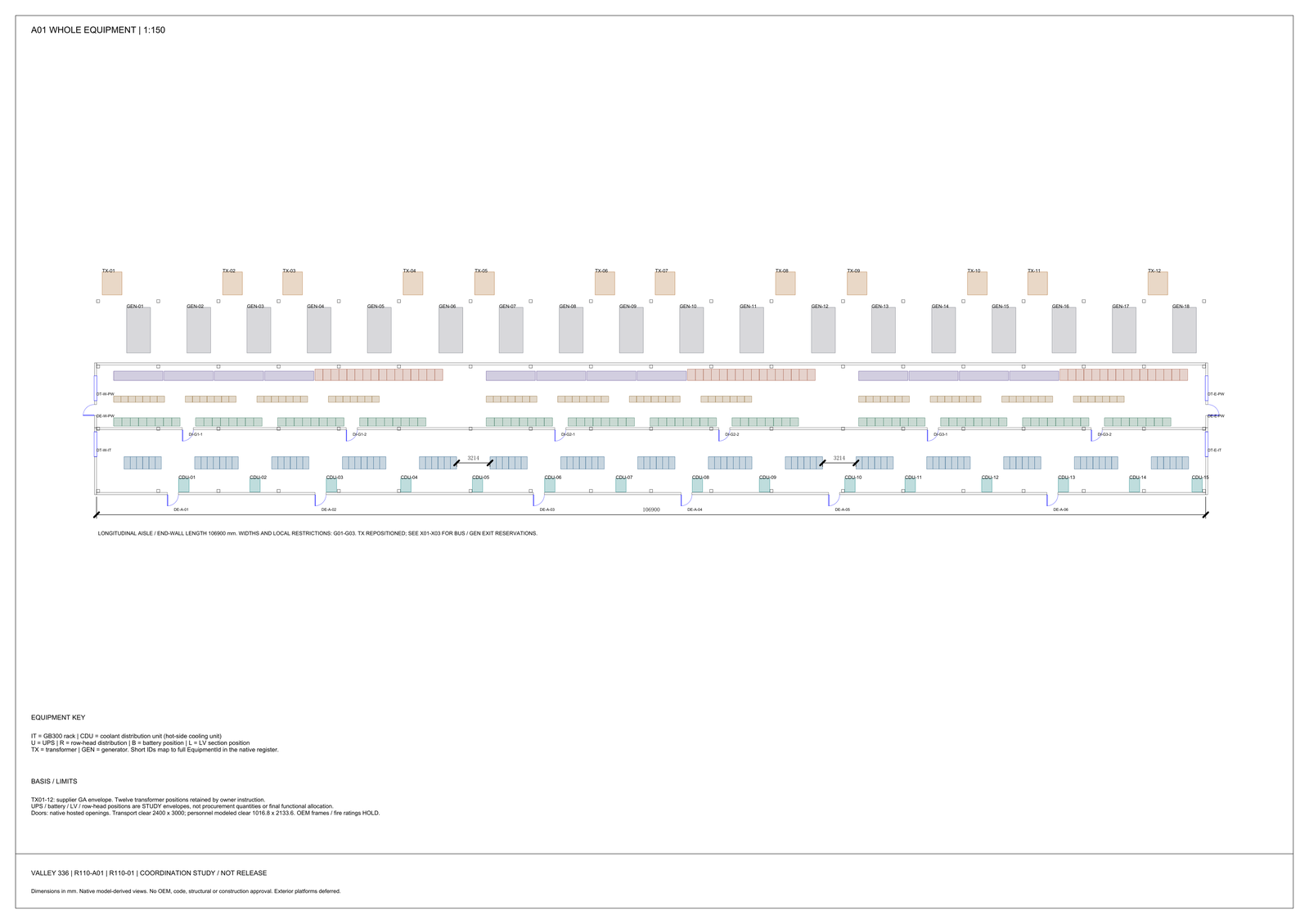
Can the switchgear be a block on the architectural sheet? The space chapter's answer is no, and the reason is not appearance. A filled region has no connector. Any object holding at least one port in the declared closed set must exist in the three-dimensional model as a connectable instance carrying connectors. The chapter then names five permitted-looking alternatives and prohibits each by name [TARGET]. None of the five looks wrong on a sheet. Each removes a different capability, and none of the removals raises an error.
A 2D Block Has No Connector, So Topology Does Not Exist
Five consequences are distinct, which is why the rule is a table rather than a sentence:
- a two-dimensional block has no connection relationship, so the port field points at nothing and the system topology does not exist;
- a mass or in-place model has no type and no connectors and resists scheduling, so the quantity driver and the bill of materials come apart;
- a filled region, detail item or annotation family takes no part in collision checking, and three named model assertions fail together;
- a parameter-only placeholder row has no geometry at all, so nothing can demonstrate that the item fits and the area argument loses the object it was meant to verify;
- a linked image or underlay carries no data whatever.
The count is the source's own and each line is a different loss, rather than one prohibition written five ways. Ordinary CAD lines after a "connection" do not count as a built system. That software-method freeze lives in the shared engineering memory. This rule is its space-chapter form.
Three Closed Exceptions, One of Which Expires at 30 Percent
Exceptions are declared a closed set of three, which matters more than their content: anything outside them is prohibited. A concept-stage volumetric placeholder is allowed while carrying all ten mandatory fields and a maturity flag, and has to become a connectable instance before the thirty per cent stage closes — a stage recorded open everywhere in the read set, so nothing is yet overdue. Statutory two-dimensional drawings are allowed because they are drawings rather than model objects, provided their tags carry the same code as the objects. Occupation-prohibited zones may have no connectors, holding no ports, and still have to be solids that take part in collision checking rather than filled regions [TARGET]. The widths those solids would need have no value from any party, so they can currently be built only at a placeholder dimension.
A catalogue row is not a delivered file. The space chapter's own product count for drawings, models, calculations, data tables and commissioning cards is zero. Directory completeness is not a built object.
Switchgear Drawn as Boxes Cannot Verify Fault-Domain Fields
The chapter is candid about who pays. Switchgear, low-voltage boards, maintenance bypasses, distribution units and hard-wired interlock panels are the items most often drawn as boxes on ordinary projects, and they are precisely the objects this project's core argument runs through. If they are not connectable, the fault-domain and feeder fields cannot be verified along the connection relationships and the pairing matrix has to be assembled by hand — which the author calls the least reliable link in the process.
Two-dimensional statutory sheets remain the right carrier for a signed single-line. They are the second exception. They are not a substitute for the connectable instance. A tag that does not share the object code with the model is a second numbering system, and the chapter forbids it.
No Model Exists, and Six Objects Are Already Short of Ports
None of this is hypothetical in the data. The frozen Rev1 connectivity snapshot records 1,539 declared port instances and 196 unique edges [MODELED]. No model file of any kind has yet been created or verified against that snapshot. The implementation package that explains the snapshot did not start Revit. Validator PASS on the CSV is internal closure of the register. It is not a connected model.
The same snapshot records six objects short of ports against interfaces it wanted to create, the fire alarm panel and the hard-wired interlock panel among them [MODELED]. The discipline for that situation is written down: route around it and hang a gap marker, never create a dangling reference, never reuse an occupied port, never merge two real interfaces into one edge to make the count work. A block on a sheet would hide the shortage. A connectable instance would surface it.
The liquid objects that will hold those ports are sized at a ring main DN200, a unit connection DN150 and a rack branch DN50 [MODELED], and those nominal sizes hold only at the recommended secondary temperature difference. The hydraulic author states that until that difference closes no service-corridor section may be drawn at all. A pipe drawn as a line on a plan is the same class of error as a board drawn as a block.
Limits and open items
Six of the same chapter's twelve model assertions defend against failures with one shared property: after the violation the model reports nothing, the calculation reports nothing, and the drawing looks entirely normal. This representation rule belongs next to that family. Nothing in the prohibited-form table is a visual defect. Every entry is an audit that stops being possible.
Confirmed: any object with a declared port must be a connectable family instance with connectors in the three-dimensional model; the five named carriers are prohibited; the three exceptions are a closed set; a catalogue row is not a delivered model; the Rev1 register's validator PASS is not a built system. [FACT]
Modelled and unfrozen: 1,539 port instances and 196 edges on the frozen Rev1 snapshot; six objects already short of ports; DN200 / DN150 / DN50 at the recommended temperature difference. The snapshot is named. A citation of "the connection count" without that name is invalid. [MODELED]
The five-form prohibition and the three exceptions remain the chapter's representation rule, not a platform or authority determination [TARGET].
Open: a model file built against the rule; the thirty per cent upgrade of any volumetric placeholder; written extraction of the six short objects' missing ports; the secondary temperature difference that would let the liquid geometry be drawn. Nothing here has been reviewed or sealed by an Engineer of Record. No native model has been started under this rule. [HOLD]
Ask for a Connectable Instance, Not a 2D Block
The question worth putting on a sheet check is not whether the box is dimensioned. It is whether the object that holds a port is a connectable instance. If the answer is a block, a mass, a filled region, a table row or an underlay, the topology the sheet is being asked to support is not in the file.
© 2026 K&K Data Service Inc. All rights reserved. Reproduction or republication is permitted only with clear attribution to K&K Data Service Inc. and a working hyperlink to the canonical URL of this article. Excerpts must preserve the technical context, maturity labels, assumptions, and limitations. No excerpt may imply project approval, field validation, certification, or endorsement that the original article does not state.
Source: K&K Data Service Inc., “A BIM Object With a Port May Not Be Drawn as a 2D Block,” https://www.kkdatasvc.com/lab/modules-and-space/an-object-with-a-port-may-not-be-drawn-as-a-block/.
Challenge This Diagram. If your project record shows a different result, or the same failure domain under another name, we want to see it. Email inquiry@kkdatasvc.com or use the contact page.