
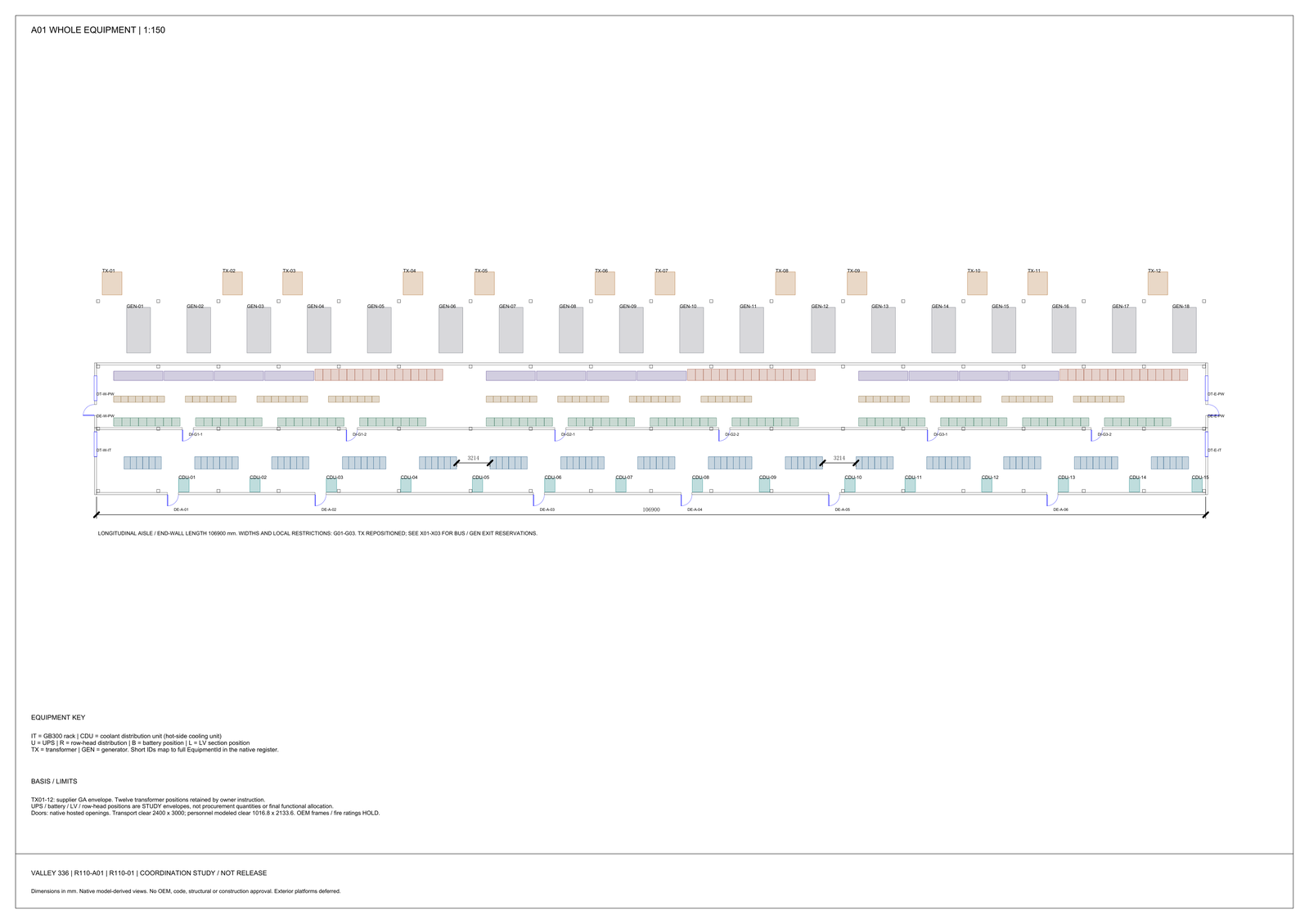
The cooling record already has a third zone that is not equal. Under the eleven-unit study base that zone is 2+1: N capacity 3.0 MW [MODELED], a quarter of the plant, against 4.5 MW and 37.5 per cent in the other two [MODELED]. Overlay planned maintenance on a single fault and that zone is short 1,296 kW, 46.3 per cent of its duty [MODELED]. The space chapter adopted a twelve-unit, three-zone skeleton so the floor would not inherit that shape. Then density walks in. At 120 and 140 kW per rack the same chapter cannot have whole-site exact division and three identical halls at once.
Only 100 kW Yields a Whole Rack Count in Each Zone
Divide a 4,000 kW zone by each studied rack density and you get 40.00, 33.33 and 28.57 racks [MODELED]. One of those is a rack. The other two are a decision. The 4,000 kW itself is 12,000 divided by three under a symmetric geometric skeleton this chapter adopted for the floor plan only [TARGET].
At the lowest step every zone takes 40 racks, the site takes 120, and installed capacity lands exactly on target [MODELED]. Nothing has to be bought and nothing has to be conceded. The middle and top steps each split into two schemes. Symmetry costs 34 racks in every zone, 102 site-wide at 12,240 kW installed, or 29 in every zone, 87 at 12,180 kW [MODELED]. The cheaper scheme gives one zone an extra rack — 34-33-33 or 29-29-28 — and stops there.
Across the whole site the picture is tidier still and easier to misread. The first two steps divide 12,000 kW exactly into 120 and 100 racks. Only the third leaves a remainder: 85.71 rounded up to 86 with 40 kW spare [MODELED]. Site-level divisibility is not the property that matters here. Zone-level divisibility is, because the zone is the unit that carries a cooling group, a feeder and a fault domain.
120 and 140 kW Cost Spare Racks or a Lasting Zone Offset
The extra positions carry no load. The higher installed figure is a position count multiplied by a nameplate rather than a raised design load. The cooling and electrical chapters still size against 12,000 kW.
The asymmetric option is priced differently. One rack more in a zone of thirty-three or twenty-eight means that zone's cooling and distribution load runs 3.0 or 3.4 per cent above its neighbours, permanently [MODELED]. A remainder rack is not a rounding artefact. It is one cooling group and one feeder carrying a structural offset for the life of the hall.
Three per cent would be unremarkable on a project with room to absorb it. This one has none. An earlier red-team conclusion already established that normal load cannot be split evenly between the two incoming feeders, because the smaller would exceed its capacity by about 0.196 MW and mechanical and common loads have to be biased towards the larger [MODELED]. The balancing margin is spent. Adding a second structural offset to a floor plan that could avoid it is what the recommendation refuses. The area cost of the empty positions is stated as below one per cent [SENSITIVITY] — one or two extra pitches in one row, and nothing at all added to the column width. Whether an unloaded position still has to be fed, cooled, metered and counted in a fault domain has not been answered anywhere in the read set, so below one per cent may not be the whole bill.
The recommendation itself is a change candidate, not an adopted layout.
Equal Cooling Groups Do Not Make Equal Rack Counts
The twelve-unit skeleton exists because the eleven-unit study base already failed a symmetry test the cooling chapter ran first. The shared memory still carries 11 × 1.5 MW in a 3+1 / 3+1 / 2+1 grouping. The hydraulic basis keeps that branch, the twelve-unit branch and the fifteen-unit branch all HELD. The space chapter marks the twelve-unit set ACTIVE as a geometric envelope only. ACTIVE here is not a purchase.
If the plant later falls back to eleven units, the third zone loses one in-row cooling position and white-space area only falls. That is why the space author could adopt the symmetric skeleton as an upper envelope without rewriting the shared count. Density then reopens the same question on a different axis. At 120 and 140 kW per rack the floor plan can recreate a permanent zone skew even while the cooling groups stay drawn as three equals.
Hydraulic grouping and rack-count grouping are not the same object. Making the cooling groups equal does not make the rack counts equal. Only the 100 kW step does both.
Pipe Size Can Freeze; Zone Rack Count Cannot
One decision in this area has already been taken the other way round. The hydraulic author standardised the rack branch at DN50 across 80 to 150 kW per rack [MODELED], precisely so that density uncertainty lands in quantity rather than in specification. That is the only procurement step the cooling chapter calls safe to bring forward while the density item stays open. A pipe size can be fixed while a rack count floats.
No equivalent exists on the floor plan. If the rack specification returns fixed-capacity units that cannot be subdivided, per-zone rack count follows that granularity rather than arithmetic division, and the registry logs the unknown as the second space blocker. A different conclusion follows. The division table then stops being the operative arithmetic altogether rather than merely needing revision.
Limits and open items
Confirmed: among the three studied steps only 100 kW per rack satisfies whole-site exact division and three identical zones at once; at 120 and 140 kW those two conditions are mutually exclusive; the extra positions in the symmetric schemes are unloaded buffer, not a raised design load; the 4,000 kW zone is 12,000 divided by three under a geometric skeleton, not a selected plant. [FACT]
Modelled and unfrozen: 40.00 / 33.33 / 28.57 racks per zone; 102 positions at 12,240 kW and 87 at 12,180 kW; 34-33-33 and 29-29-28; 85.71 rounded to 86 with 40 kW spare; the 3.0 and 3.4 per cent zone offsets; the 0.196 MW feeder bias used as the reason three per cent is expensive; the 3.0 MW / 25 per cent third-zone share and the 1,296 kW, 46.3 per cent maintenance-plus-fault short on the eleven-unit branch. None of the three density steps is selected. None of the three cooling-unit counts is purchased. [MODELED]
The area cost of the empty positions remains a stated ceiling below one per cent [SENSITIVITY], not a computed bill.
Open: the owner's density step; pod or scalable-unit granularity; whether an unloaded position is still a fed, cooled, metered object in the fault domain; the change candidate that would buy the empty positions; the cooling-unit count, which the hydraulic basis keeps as three HELD branches. The twelve-unit geometric skeleton is a conditional basis. The shared record still carries the eleven-unit arrangement whose third zone is not symmetric with the other two. [HOLD]
Nothing here has been reviewed or sealed by an Engineer of Record. Nothing releases a rack count for purchase.
If Not 100 kW, Give Up Exact 12 MW or Three Equal Halls
The useful question is not which density is denser. It is which of the two integers the owner is prepared to give up if the step is not 100 kW per rack: whole-site exact division, or three halls that are actually the same hall. The cooling chapter already showed what an unequal third zone costs in capacity. The floor plan should not have to learn that a second time from a remainder rack.
© 2026 K&K Data Service Inc. All rights reserved. Reproduction or republication is permitted only with clear attribution to K&K Data Service Inc. and a working hyperlink to the canonical URL of this article. Excerpts must preserve the technical context, maturity labels, assumptions, and limitations. No excerpt may imply project approval, field validation, certification, or endorsement that the original article does not state.
Source: K&K Data Service Inc., “Only 100 kW/Rack Divides 12 MW Into Three Equal Zones,” https://www.kkdatasvc.com/lab/modules-and-space/only-100-kw-rack-divides-12-mw-into-three-equal-zones/.
Request the Public Calculation Note. If your project record shows a different result, or the same failure domain under another name, we want to see it. Email inquiry@kkdatasvc.com or use the contact page.