
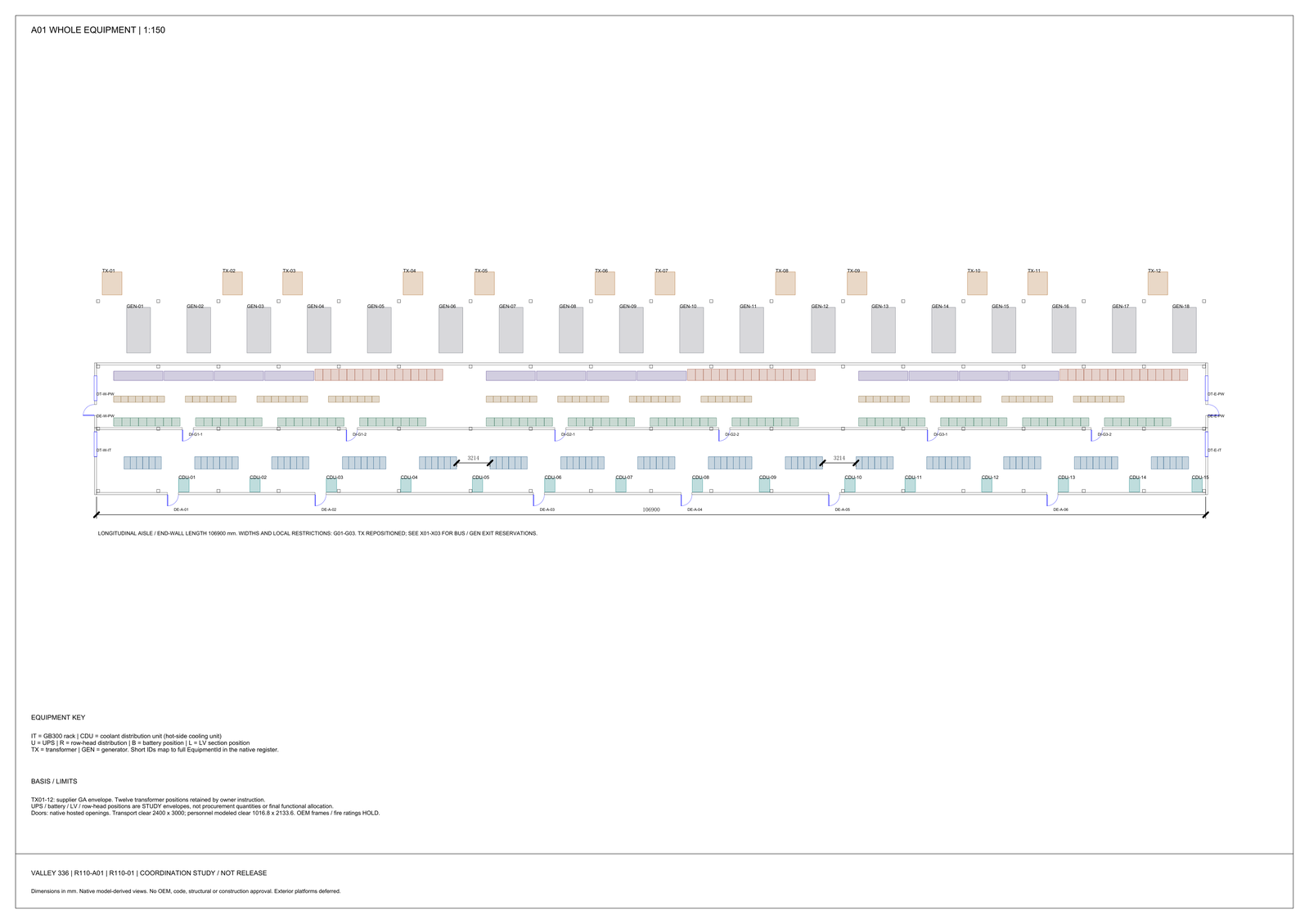
The space chapter could have copied 1.22 m from the code table into the aisle and closed the cell. It did not. It wrote a maximum of two quantities rather than a number: the front working clearance is the larger of the code minimum and the maximum extraction depth plus a 0.9 m transport margin [TARGET]. In the one case printed in full the second quantity wins, and the baseline aisle is 1.50 m where the code allows 1.22 m [MODELED]. A breaker truck, not a code table, sets the width of the low-voltage aisle on this project.
Aisle Width Is the Larger of Code and Extract-Plus-Margin
The code table gives 0.9, 1.07 and 1.22 m for the three working-space conditions at this voltage [TARGET]. The chapter starts from the middle one because the opposite face is an earthed metal enclosure. Which condition actually applies to each lineup has not been determined. That is a per-lineup judgement a licensed engineer still owes. The chapter's choice is a conservative working assumption, and it labels it as one.
The 0.9 m in the code table and the 0.9 m in the transport margin are not the same object. Condition 1 is a statutory floor for a working space with exposed live parts on one side and no live or grounded parts on the other. The transport margin is an engineering allowance for turning a withdrawn truck or module and moving it away from the lineup. Using the code 0.9 m as the aisle design value is the error the maximum exists to prevent.
What the rule adds is an argument about form. Every critical item here is withdrawable or modular, so the governing dimension is a manoeuvre rather than a cabinet depth. A rule stated as a maximum survives a change of model where a single number does not. That is the case for putting it into the design standard, and it is raised as a change candidate for exactly that.
A second code clause does not wait for the maximum. All critical low-voltage gear on this plant is 3,000 to 3,200 A [MODELED]. The chapter records a two-exit hit under NEC 110.26(C)(2) as a baseline assumption, not as an engineer ruling [TARGET]. Door positions remain to be confirmed. The aisle rule sets width. The two-exit clause, where it applies, sets the room.
Breaker-Truck Turning, Not the Code Table, Sets the Aisle
Replacement paths are treated as an input that sets a room's proportions and its door positions, not as a check run afterwards. Under that treatment the low-voltage lineup's breaker truck, 0.15 to 0.4 tonnes, is withdrawn at the front and then turned through ninety degrees, needing at least 1.5 m [MODELED]. The chapter names that as the reason its baseline is 1.50 rather than the code figure. Modular power units are pulled out in service under the same rule. Battery modules inherit it unchanged and add a requirement the electrical rooms do not carry: a temporary standing position for the removed module. Outdoors the same maximum reappears with its second limb widened to cover dismantling for heat-exchange surface cleaning.
No supplier has returned a maximum extraction depth for any item. On the current record the limb that wins in the printed case is itself an engineering assumption. The arc-flash calculation that would set the real usable working distance has not been performed either, and the chapter records that it has to feed back into this clearance when it is.
White-space aisles are a different application of the same floor. The hot-aisle lower envelope of 0.90 m [MODELED] holds only where no live equipment needing front access faces that aisle. A licensed engineer has to confirm that per aisle. Raise the clear height far enough that work faces sit above ladder reach, and a mobile platform has to roll the aisle. The aisle floor then rises to take the chassis. Height and aisle width are one lock.
Install opening and replacement opening are two objects
The structural basis draws a distinction the aisle rule does not, and declines to rank its two sides. A temporary construction opening available during installation is not a replacement opening available across the building's life. For batteries, modular power units, cooling distribution units, transformers and generators, both paths have to be proved separately. Where they differ the model has to carry different route objects and states. Nothing in that section makes one path govern the other. In this chapter the installation quantity is the wider of the two: the heavy-item corridor runs 2.6 to 3.6 m at a rated capacity of at least eight tonnes [MODELED] against a front clearance of 1.20 to 1.80.
Paths are also where checking stops helping. Every quantity a route object must carry is awaiting supplier, lifting-plan or engineer confirmation, and the structural author forbids giving any of them an experience value:
- clear width and clear height along the whole run, including under any overhead service;
- minimum turning radius and maximum gradient, which together decide whether a corner exists;
- permissible wheel load, total mass, maximum axle load and crane outrigger reaction;
- the removable door, wall or roof units, the temporary laydown area and the occupation-prohibited state that keeps later disciplines out.
In the connection register these objects live among 704 exempt ports of which 652 are legitimately unconnected [MODELED], so a connectivity check will never notice one missing. That result proves machine closure of the register. It proves nothing about topology, capacity, existence or constructability.
Limits and open items
Confirmed: the 0.9 m in Condition 1 is not the 0.9 m transport margin. [FACT]
Modelled and unfrozen: 1.50 m where the code allows 1.22 m; 0.15 to 0.4 tonnes for the truck; 2.6 / 3.0 / 3.6 m and eight tonnes for the heavy corridor; 1.20 to 1.80 m front-clearance band; 3,000 to 3,200 A; 704 exempt ports with 652 unconnected; the 0.90 m hot-aisle lower envelope. No supplier extraction depth sits behind the winning limb. [MODELED]
The front working clearance written as the larger of the code minimum and extract depth plus 0.9 m, the 0.9 m margin, the three code minima, and the two-exit hit remain recommended targets and a baseline assumption, not a sealed standard or an engineer ruling [TARGET].
Open: a written maximum extraction depth for each withdrawable item; a per-lineup determination of working-space condition; the arc-flash calculation that feeds back into usable distance; a per-aisle ruling on whether the 0.90 m hot aisle faces live gear; the two path objects, installation and replacement, carried separately in the model. Someone must name the party who returns the first extraction depth, because until one arrives the rule is complete and the number is not. [HOLD]
Nothing here has been reviewed or sealed by an Engineer of Record. Nothing releases an aisle width for construction.
Which Supplier First States a Maximum Extraction Depth
The useful question is not what the code allows. It is which supplier drawing first states a maximum extraction depth, because that is the quantity the aisle will actually be drawn from.
© 2026 K&K Data Service Inc. All rights reserved. Reproduction or republication is permitted only with clear attribution to K&K Data Service Inc. and a working hyperlink to the canonical URL of this article. Excerpts must preserve the technical context, maturity labels, assumptions, and limitations. No excerpt may imply project approval, field validation, certification, or endorsement that the original article does not state.
Source: K&K Data Service Inc., “Breaker Extract Depth Plus 0.9 m, Not Code Minimum, Sets the Aisle,” https://www.kkdatasvc.com/lab/modules-and-space/extract-depth-plus-0-9-m-not-the-code-minimum-sets-the-aisle/.
Challenge This Diagram. If your project record shows a different result, or the same failure domain under another name, we want to see it. Email inquiry@kkdatasvc.com or use the contact page.