
Two documents dated the same day name the same heat-exchanger model under two item identifiers. One rating point is 900 kW. Estimated on the first document's fluid properties, the second point corresponds to about 700 kW [MODELED]. The flows sit at 67.3 and 100.1 m³/h against 52.2 and 77.6 m³/h [MODELED]. The reviewer declined to read that as a capability limit on the delivered unit and concluded only that the supply record is not closed. Reading that collision as the envelope an owner would freeze density against is the author's inference, not the reviewer's. The supply record is unsettled at its duty before the unit is even drawn.
Rack Form and CDU Geometry Bound Density, Not the Reverse
Rack power density is the input everybody wants to decide first, because it has a tidy table and three clean steps. It also has no authority over the two inputs that bound it. The maturity declaration in the same chapter is explicit about the asymmetry: density may be parameterised, while the two geometry items may only be enveloped. The space chapter registers rack form as unobtained and in-row cooling geometry as unknown. Against the second it records something sharper than an incomplete answer: no supplier document of any kind exists [TARGET].
Direction is fixed by physics rather than by preference. A rack at the top density step is almost certainly 800 to 1000 mm wide and 1400 mm deep with side manifolds [MODELED], so it cannot occupy the narrowest pitch column the area table offers. The envelope bounds the density. The density does not bound the envelope. Deciding density first can therefore select a step the equipment form will not accommodate. The chapter draws the ordering itself: in-row cooling geometry and rack form rank at or above density.
Density Fixes Only the IT-Rack Count, Not Row Length
Each zone row carries three occupancy classes — information-technology racks, in-row cooling units and air-side terminals — and only the first has a count derived from density [MODELED]. The second follows a conditional geometric basis whose branch is unfrozen. The third is an assumption driven by the liquid fraction. Freezing density fixes one term of three and leaves the row length open. That is why the result depends on an input nobody has requested rather than on the one everybody is discussing.
What the chapter permits either way is instructive. Density may be frozen as a parameterised range and its sensitivity, never as a single value. Rack form and cooling geometry may be frozen as position-width and in-row footprint envelopes, never as a dimension, a clearance or a connection-face orientation. The in-row pitch itself is carried as 0.60 / 1.20 / 2.00 m [MODELED], a pure envelope. Everything a schedule wants is on the prohibited side of that line. Both envelopes are graded as an assumption until a supplier writes something down.
The Vendor Five-Cabinet Object Is Not the Plant CDU Count
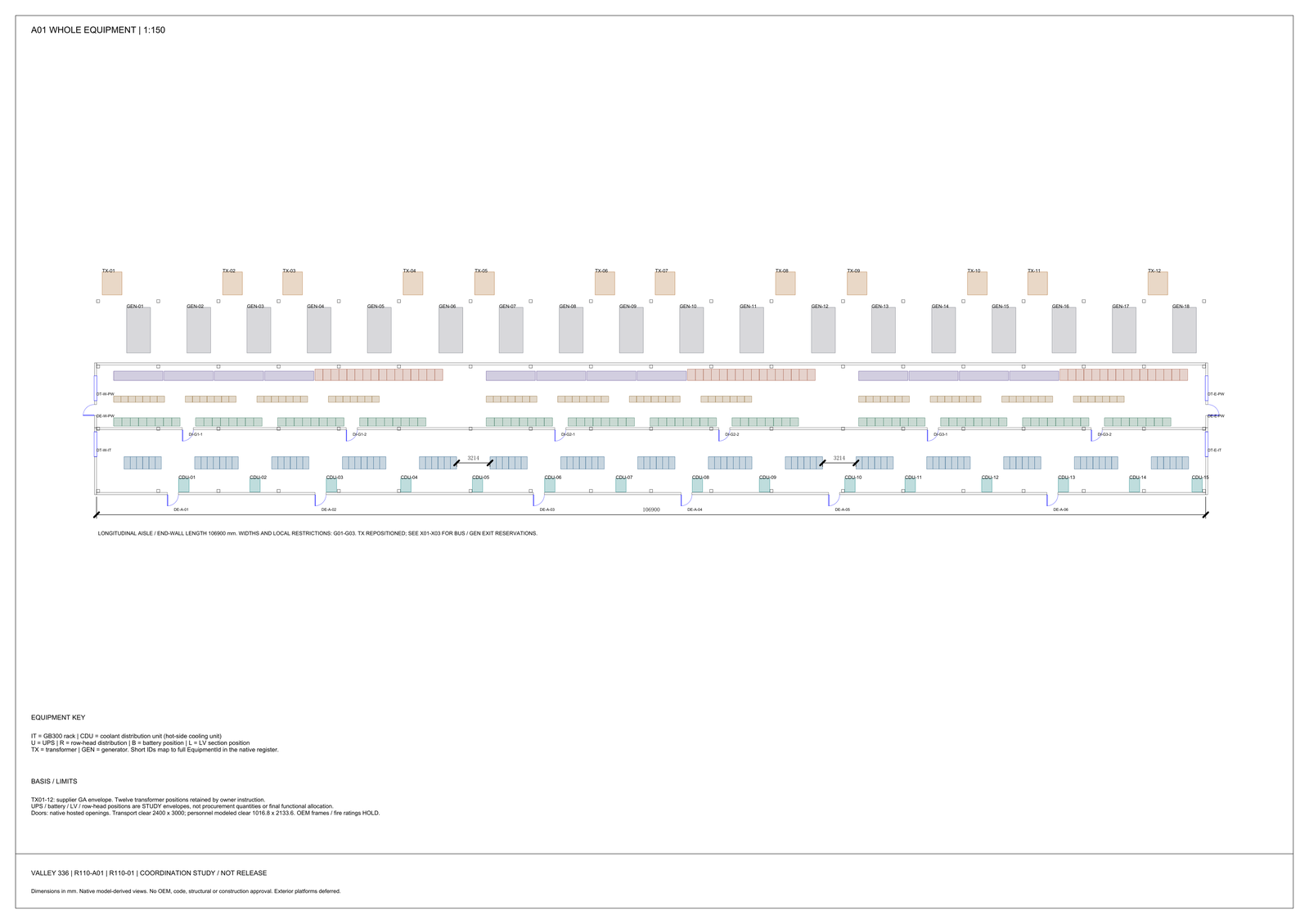
The 900 kW / 700 kW collision belongs to a vendor five-cabinet, dual-900 kW review object serving ninety racks [MODELED]. It is not the plant in-row count. The design-package branches are 11, 12 and 15 units at 1.5 MW [MODELED]. The hydraulic basis keeps all three HELD. The space chapter marks the twelve-unit set ACTIVE as a geometric skeleton only. ACTIVE here is not a purchase. Adding the three branches, or reading the vendor 900 kW unit into the 1.5 MW nameplate, produces a plant that exists in neither file.
The vendor three-dimensional model of the cooling unit is a preliminary sketch. It carries no bill of materials, no support reactions, no maintenance or transport envelope, and no port table. Dry-cooler pads do not prove the in-row unit can be installed. Closing "the CDU/rack envelope" on this project means the space-chapter geometry items, not the vendor item identifier.
A further duty question sits on the plant nameplate itself. If 1.5 MW was written on water and the secondary fluid is glycol, the same unit may be 1.20 to 1.28 MW [SENSITIVITY]. That finding is still open. It is another reason the envelope is not a number that density can be frozen against.
In-Row Service Space Is Reserved at a Size Nobody Can Test
The withdrawal and connection working position for the in-row unit sits in the maintenance register as a pure envelope. It carries a hard constraint that it may not overlap the front-maintenance space of the adjacent racks. The heavy-item path check marks it partial and blocked on the same unknown. Whether an in-row replacement requires the whole row to be stopped is an open question that cannot be answered until the geometry arrives. Reserving space whose sufficiency nobody can yet test is the only honest thing to do with it in the meantime.
One decision in the same read set was successfully brought forward, and it shows what an early freeze needs. The hydraulic author standardised the rack branch at DN50 across 80 to 150 kW per rack [MODELED], isolating the uncertainty in quantity rather than in specification. That is the only procurement step the cooling chapter calls safe to bring forward while the blocking items stay open. A coupling bore significantly smaller than the standardised branch would cancel the advantage at the coupling itself. Nothing in the read set suggests either envelope is close to arriving. The ordering argument is worth more the longer that stays true.
Limits and open items
Confirmed: the twelve-unit geometric mark is not a purchase; the vendor five-cabinet object is not the plant count. [FACT]
Modelled and unfrozen: 800 to 1000 mm by 1400 mm at the highest density step; three occupancy classes of which only one follows density; 0.60 / 1.20 / 2.00 m in-row pitch; 11 / 12 / 15 plant units; the 900 kW and about-700 kW rating points; 67.3 / 100.1 m³/h against 52.2 / 77.6 m³/h; DN50 across 80 to 150 kW per rack. None is a frozen dimension. [MODELED]
The 1.20 to 1.28 MW glycol derate remains a sensitivity on an unconfirmed nameplate fluid [SENSITIVITY].
Open: no supplier document exists for in-row cooling-unit geometry; rack form is unobtained; density is unfrozen [TARGET]. Written manufacturer geometry for the in-row unit and the rack; a written statement relating the two same-day item identifiers; the coupling bore against the standardised branch; whether in-row replacement stops the whole row; the change candidate that would split the single registered input into a density item and a form-geometry item. Priority of work is cooling-unit geometry and rack form at or above density [TARGET]. Closing density first does not settle the floor. [HOLD]
Nothing here has been reviewed or sealed by an Engineer of Record. Nothing releases a cooling-unit count or a density step for purchase.
Density has the table. The envelope has the authority.
Density has a tidy table and no authority. The envelope has no table and all of it. The drawing that would reverse that is a supplier width, depth, height and service face, written for the unit that will actually stand in the row.
© 2026 K&K Data Service Inc. All rights reserved. Reproduction or republication is permitted only with clear attribution to K&K Data Service Inc. and a working hyperlink to the canonical URL of this article. Excerpts must preserve the technical context, maturity labels, assumptions, and limitations. No excerpt may imply project approval, field validation, certification, or endorsement that the original article does not state.
Source: K&K Data Service Inc., “Close the CDU and Rack Envelope Before Freezing Rack Density,” https://www.kkdatasvc.com/lab/modules-and-space/close-the-cdu-rack-envelope-before-you-freeze-density/.
Discuss This Constraint. If your project record shows a different result, or the same failure domain under another name, we want to see it. Email inquiry@kkdatasvc.com or use the contact page.